Mako Shark Attack Week!!! The 1961 Mako Shark
Dateline: 1.2.12
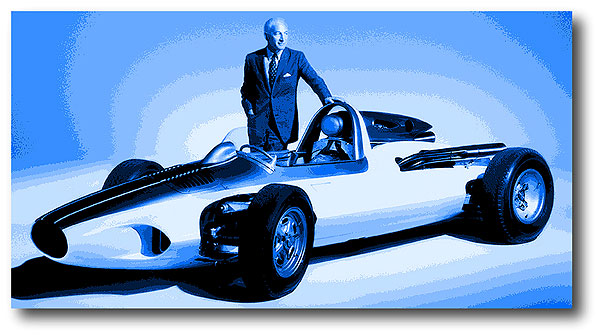
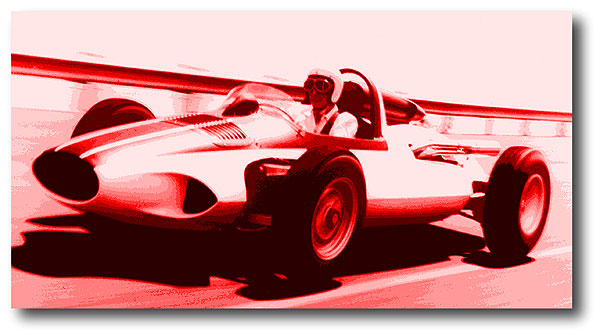
A Look Back At the First of Bill Mitchell’s Beautiful Mako Shark Corvettes
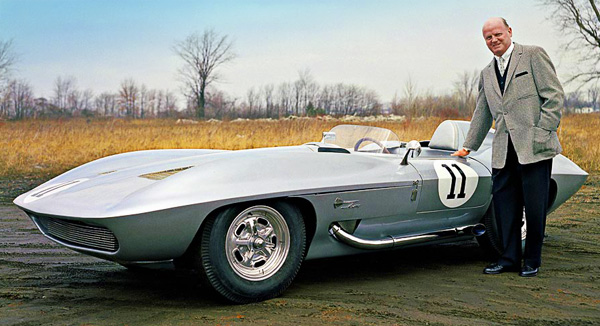
Former GM Chief of Styling, Chuck Jordan said it best about his colleague and former boss, Bill Mitchell, “The man had STYLE!” And why wouldn’t he? Can you imagine learning car design from the great Harley Earl? Mitchell was 46 years old when he took over the reins of General Motors Chief of Styling in 1958 when Earl retired. Bill’s design leadership was so prodigious that it’s often overlooked that he spent his entire 42-year professional career with General Motors. That’s something that almost never happens today.
Mitchell’s styling sense can be best described as “edgy” – figuratively and literally. Known as a snappy dresser, Bill liked to “look sharp” and designed his cars with that ideal in mind. Mitchell believed that you could tell a successful man because his cloths were pressed and sharp, so he designed cars the same way! Unlike today’s “bar of soap,” smooth, rounded designs, a common threat in Mitchell’s designs were sharp edges and creases. Note the bold horizontal crease line and edges of the Stingray Racer and the ‘63 – ‘67 Sting Ray, the Mako Shark I, the Mako Shark-II, the Manta Ray, and the production ‘68 – ‘82 Corvette. Continue reading
Corvette Timeline Tails: Happy 102nd Birthday Zora Arkus-Duntov
Dateline: 12.25.11
Where the Corvette Got Its Mojo From!
Don’t miss the Duntov video at the bottom of this post!
Corvettes are all about passion and that passion shows up in two powerful ways – visually and from performance. The two are so intrinsically connected that they seem one and the same, but a closer examination reveals that is not the case. Of course, the first thing one notices about the Corvette is its looks. The car’s appearance is totally unique, even though it did borrow a little here and there from other designs. But at the end of the day, the completed design only looks like a Corvette.
But looks will only get you so far. What completes the Corvette addiction is the visceral experience of driving one. To “get” the Corvette, you must drive the car. And if the driving experience was now much different from a mushy sedan, what’s the point? No, if the Corvette didn’t deliver responsive performance with gobs of sensory input for the driver, the car surely would have gone quietly into the night, fading into automotive obscurity, along with a long list of once interesting cars.
So who was responsible for infusing the Corvette with it’s Mojo? Zora Arkus-Duntov. Zora was, without a doubt, the ultimate automotive corporate misfit to ever work in Detroit. By the time he saw the very first Corvette at the 1953 Motorama, he was 44 years old, a seasoned mechanical engineer, race car driver and builder. he was quoted as saying, “When I saw the Corvette at the Motorama, I thought it was the most beautiful car I’d ever seen.” And Duntov appreciated beauty. Just look at his stunning blond beauty wife and former Bluebell Girls dancer, Elfie Duntov. yes, Zora new a good-looking dame when he saw one and one look at the Corvette and he knew where he wanted to be – in the engineering department of Chevrolet, working on the Corvette. Continue reading
Zora Arkus-Duntov’s Mule Corvettes – Zora’s Toys
Dateline: 12.24.11
While Zora never got a custom Corvette, he still had some very cool Corvette toys!
Zora Arkus-Duntov Birthday Weekend continues here at CorvetteReport.com. Over the last few months we told you about several of the customized Corvettes that were built for Chevrolet executives. But to the best of my knowing, the man that found the Corvette’s Mojo never got a full-out Chevrolet styling department customized Corvette. He did buy a ‘74 Corvette coupe upon his retirement and by all accounts it didn’t have any performance enhancements, but it did get a unique stripe paint job.
So, Why didn’t Duntov get a custom Corvette? Maybe he wasn’t high enough up on in the GM corporate food chain. We’ll probably never know. Not that Zora didn’t have his toys. Zora’s Corvette toys were often all-out racing optioned Corvettes. Along the way of developing his various “racer kit” packages,he built an interesting array of mule Corvettes. These were cobbled together cars that were never taken out of the Chevrolet R&D center or test track.
I covered Duntov’s mules in a two-part story in my VETTE Magazine Continue reading
Zora Arkus-Duntov, Ahead of the Curve in 1953!
Dateline: 12.23.11
Duntov’s Thoughts Pertaining To Youth, Hot Rodders, and Chevrolet

Chevrolet engineer and Duntov co-worker, Gib Hufstader, managed to save one of Duntov's DOHC experimental engines from the scrap heap! It might have been one of the above engines. Too bad they all weren't saved!
Zora Arkus-Duntov started working at General Motors on May 1, 1953. His first few months were a little bumpy, plowing through some junky assignments, such as sorting out why a prototype car with a heavy rear end wouldn’t handle right and solving a driveline vibration on a GM bus. A few weeks after Zora started, his immediate supervisor, the very capable senior engineer Maurice Olley, suggested that Duntov quit because he didn’t like Zora’s non-engineering solution to the prototype’s handling problem. And Duntov actually considered it! (for a very short time)
But ever the “GO-GO!” racer guy, Duntov had gasoline in his veins and was a pretty good writer for an engineer. Below are his thoughts on the then burgeoning aftermarket hot rod industry Continue reading
Corvette Timeline Tales: Happy 113th Birthday to GM’s First VP of Design, Harley Earl
Dateline: 11.22.11
It was Harley Earl that decided that General Motors needed to make a sports car.
Harley Earl is arguably the greatest designer in American automobile history. And not just because of the Corvette. Some of Earl’s classic designs include the Buick Y-Job, the 1928 LaSalle Phantom, the Firebird Series, the Cadillac Cyclone, and others. He was also credited for inventing concepts that are today, simply taken for granted. From the website, www.CarOfTheCentury.com, here’s a list of 13 concepts that Harley Earl invented:
1. Founder of the Automobile Design Profession in America
2. Inventor of the Concept car, also know as the Dream Car
3. The introduction of the Annual Styling Model Change
4. The Father of Modern Design Change in Mass production
5. The Dean of America’s Auto Design Protégés
6. The Motorama Show (where the Corvette had it’s first outing)
7. First to introduce the concept of clad modeling to Detroit
8. The Father of the Corvette
9. Opened “Harley Earl Corporation” outside of General Motors in 1945
10. Father of the Modern Car & Creator of America’s Small Car Trend
11. Harley Earl was a Giant “Advocate of Women’s Rights in the Auto Industry”
12. Invented the “Graphic Engineering” profession
13. First to introduce “Color Revolution” to Detroit’s auto world
I’m sure that the above list of 13 accomplishments should be considered a “starter list.” For fans of the olden days of automobile design, this site is a delight… http://www.carofthecentury.com Without a doubt, Harley Earl cast an enormous shadow upon General Motors.
A close second was Earl’s successor, Bill Mitchell. When Mitchell resigned in 1977, GM’s top management decided that NEVER AGAIN would “Design” have as much power as Mitchell and Earl wielded. When Mitchell left, the “focus group” model took over. Continue reading
Special Interest Autos’ – SIA – 1957 SS Corvette Feature Story
Dateline: 11.2.11
Hemmings Motor News old sister publication takes a look back at the first special-built Corvette race car, the SS Corvette

Special thanks to Hemmings Blog for the image. For more very cool car stories, visit http://blog.hemmings.com/. I go there every day!
(Be sure to check out the SS Corvette video at the bottom of this post!)
Back in the early ‘80s there was a new trend in the car magazine biz – specialty publications. Marty Schorr’s VETTE Magazine was ahead of the curve when it came out in ‘76. VETTE was the first “Corvette-only” news stand magazine ever published. By the early ‘80s there was a specialty publication for most brand cars. Hemmings Motor News branched out with a unique magazine called, “SIA – Special Interest Automobiles.” While I remember seeing the magazine on the news stands it wasn’t something I was interested in back then, as it featured many pre-WW II “classic” cars, and I was interested in other things at the time.
Fast forward to today and the wonderful world of blogging, Hemmings has one of my favorite car blogs. It’s the preverbal “box of chocolates” because “you never know what you’re going to get.” (thank you Forrest Gump!) Recently at http://blog.hemmings.com/ they posted an interesting and detailed story about the 1957 SS Corvette race car from the October 1988 issue of SIA magazine.
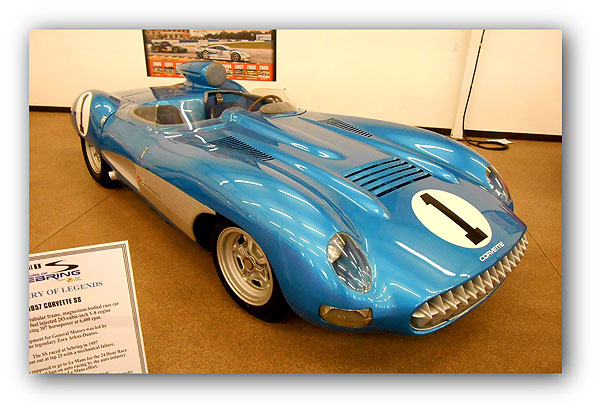
Don’t let the rather scathing introduction put you off, “…the SS was little more than a poorly executed and slapdash affair, deserving of its failure at Sebring and merely spared the pain of further embarrassment… “ The actual article from SIA is very good with lots of pictures, statistics, and some nice technical illustrations of the SS Corvette.

Special thanks to Hemmings Blog for the image. For more very cool car stories, visit http://blog.hemmings.com/. I go there every day!
This is just my opinion, but I think that the introduction was a little unjust for the following reasons. While it is true that Duntov and his team copied the Mercedes 300SL race car’s birdcage frame and chassis, so did many other cars. The design was the standard road racing layout of the day. General Motors of the mid-’50s was arguably the least prepared auto company to even take on such a project, as they had NO experience what-so-ever in building race cars. The only part of the car Chevrolet engineers were familiar with was the 283 Fuelie engine. Plus, the small-block was only in its third year of production and F.I. unit was brand new. Continue reading
Corvettes Unlimited of Vineland New Jersey’s Glass & Steel Show
Dateline: 10.26.11 (This is our 200th post!)
Corvette & Classic Car Autumn Fun in New Jersey
(Check out to six slide shows at the bottom of this post!)
Autumn in New Jersey makes up for Summer in New Jersey. If you can live in Jersey, you can live almost anywhere, as we get it all – LOTS of snow in the winter, below freezing temps in the winter, 100-degree temps with 95% humidity in the Summer and an occasional huricane. But when October rolls around, it’s PERFECT! And a fantastic time for a car show.
Corvettes Unlimited of Vineland, New Jersey changed their venue for their annual car show from Wheaton Village, in Millville to the Michael Debbie Park in Buena Vista. To draw more attendees, the club opened up the show to classic and muscle cars, hence the new name for the show, “The Glass & Steel Show.” While it turned out there there was more steel than glass, it was a delightful show just the same. I for one enjoyed the steel side as much as the glass side.
I took LOTS of pictures, so we have several slide shows to share with you below. Enjoy! – Scott

The People's Choice Award went to: Michael T. Cafarelli, of Minotola, N.J. - 2006 white coupe. The Best of Show Award went to: Gary & Patty Rickets of Salem, N.J. - 1965 silver & red Sting Ray coupe.
Here are the winners. All of the Corvettes in the show can be seen in the below slide shows.
Stock: 1963-1967 – 1st. place: Ole Olson, Northfield, N.J. – 1966 Red Convertible
Stock: 1968-1973 – 1st. place: Joe Biaselli, Vineland, N.J. – 1973 blue convertible
Stock: 1968-1973 – 2nd place: Louis Rodolico, Aston, Pa. – 1976 red coupe
Stock: 1968-1973 – 3rd. place: John O’Brien, Egg Harbor Township, N.J. – 1973 orange coupe
Stock 1974-1982 – 1st. place: Oscar Pierce, Bridgeton, N.J. – 1978 red coupe
Stock 1974-1982 – 2nd. place: Richard Thomas, Pittsgrove, N.J. – 1982 silver coupe
Stock 1983-1996 – 1st. place: Joseph Burrell, Williamstown, N.J. – 1984 red sport
Stock 1983-1996 – 2nd. place: Wayne Wright, Little Egg Harbor, N.J. – 1996 silver convertible
Stock 1983-1996 – 3rd. place: Jon E. Bowen, Pennsville, N.J. – 1994 dk. red coupe
Stock 1997-2004 – 1st. place: Carmen Petrongio, Vineland, N.J. – 2002 blue coupe
Stock 1997-2004 – 2nd place: Linda & Lou Deman, Nesco, N.J. – 2003 red convertible
Stock 2005-2012 – 1st. place: Dennis Enoch, Cherry Hill, N.J. – 2008 black convertible
Stock 2005-2012 – 2nd. place: John Ormsby, Glassboro, N.J. – 2008 red convertible
Stock 2005-2012 – 3rd. place: Buster Petonglo, Newfield, N.J. – 2009 blue Z06
Modified 1953-1967 – 1st. place: Paul Rickets, Pennsville, N.J. – 1966 blue convertible
Modified 1968-1975 – 1st. place: Bill& Dawn Merola, Egg Harbor Twp., NJ 1973 red convertible
Modified 1976-1982 – 1st. place: Bill & Sandy Ward, Mullica Hill, N.J. – 1982 grey coupe
Custom 1953-2012 – 1st.place: Gary & Patty Rickets, Salem, N.J. – 1965 silver coupe
Custom 1953-2012 – 2nd. place: Jonathan Settrella Bridgeton, N.J. – 1976 red coupe
People’s Choice: Michael T. Cafarelli, Minotola, N.J. – 2006 white coupe
Best of Show: Gary & Patty Rickets, Salem, N.J. – 1965 silver coupe
To access the slide shows and Continue reading
Vette Polls: Would You Buy A New, Factory-Built Retro Corvette?
Dateline: 10.20.11
If Chevrolet offered brand new C1, C2, and C3 Retro Corvettes, would you buy one?
Take our Poll at the bottom of this post.
The other day I posted a story featuring a collection of make-believe Chevy billboards titled, “Billboards We’d Like to See”. (check it out HERE) Without really thinking deeply about it, my subtitle was, “If Chevrolet was to make retro Corvettes, would billboards such as these help sell cars?” The subtitled popped into my head because as I was looking at the mocked up Corvette billboards, I was struck by just how beautiful the C1, C2, and C3 cars were.
Now this would never, ever, ever happen – but it’s fun to imagine. The basic idea would be this. Start with two Corvettes from each of the first three generations. Let’s say a ‘57 and a ‘62 for the C1 group, a ‘63 and a ‘67 for the C2 Sting Ray group, and a ‘69 and a ‘78 for the C3 group. The idea would be to take the original designs and update the drivetrains, wheels, tires, and brakes, safety requirements, and interior materials and creature comforts. Aside from modern paint colors, wheels, and tires, they would look very much like their original counterparts. They need not be quasi race cars, loaded to the gills with hi-tech hardware. Just brand new, modernized, old-style Corvettes. Sound interesting? So, let’s look at each component.
Engine & Drive Train: Each car could be powered by an LS3 engine, coupled with a 6-speed manual or automatic transmission. Suspensions should use essentially the original design layout, but with modern shocks, correct anti-sway bars, bushings, steering, etc. The frames should be patterned after the originals, but strengthened in all the known areas of weakness and modified to accept wider tires.
Wheels, Tires, & Brakes: The modified frames could accept tires with modern widths. The wheel diameters should stay at 15-inches so that the wheel/tire proportion looks period correct in the wheelwells. Wheels should be spun-cast aluminum and period styled. C1s could get 15×8 Halibrand styled wheels. C2 and C3 cars could get 15×8-inch spun-cast aluminum Rally wheels or finned knock-odd-style wheels. Brakes should be modern C6 base model brakes.
Interior: The dash layouts should stay true to their original design, but with upgraded electronic gauges, Bose sound system, airbags, modern leather bucket seats (the original C2 and C2 buckets are really just narrow bench seats), A/C, electric windows and side mirrors, and Nav system. These are cruisers, so the emphasis is on comfort and amenities.
Body: The C1 and C2 cars should get small ‘67-’69 Z-28-style chin spoilers. The C2 cars need a slight forward rake to keep the front end down at higher speeds, All of the cars need to be slightly lowered too. There should be optional hoods. Headlights should be modern LED units but styled in period correct housings. Continue reading
Corvettes Score 23% in Edmonds 100 Greatest Chevrolets List
Dateline: 9.27.11
Of the 23 Corvettes Edmonds picked, vote for your favorite at the end of this post!
Back on September 14, 2011 we shared with you the results of Chevrolet’s Centennial birthday celebration popularity contest to find the most popular Chevrolet of all-time. Like American Idol or Dancing With the Stars, the Greatest Chevy contest was a popularity contest. Certainly an argument could be made as to why the C6 ZR1 is the greatest Chevy of all-time because of its overall performance, the LS9 engine, top speed, etc. But that’s not what Chevrolet wanted to know. They wanted to know what was the most “favorite” Chevy of the last 100 years.
Well it seems that the people at Edmonds.com decided to draw up their own list of great Chevys. The 100 top Chevys list isn’t limited to production Chevrolet cars, but includes, race cars, prototypes, and show cars. Of the 100 cars in the list, 23 were Corvettes! Pretty impressive for a low-volumn, limited usage automobile. The list doesn’t appear to be in any specific order and there’s a slide show of all 100 cars too. Also, the story does not explain how this list was drawn up. Regardless, it’s interesting just the same. To review the Edmonds story, CLICK HERE.
Here are the 23 Corvettes:
1. 1953 Corvette – The First Corvette.
2. 1955 265 V8 Corvette – The first V8 Vette.
3. 1957 Fuel Injected Corvette – The First Fuelie Corvette
4. 1956 SR-2 Corvette Race Car
5. 1957 Corvette SS Race Car
6. 1959 Stingray Racer – Bill Mitchell’s race car playtoy Continue reading
Corvette Timeline Tales: Happy 102nd Birthday, Ed Cole
Dateline: 9.17.11
“Kick the hell out of the status quo!” – Ed Cole

Ed Cole was one of what I call, “The Four Fathers of the Corvette.” The first Father of the Corvette was Harley Earl, the designer and creator of the Corvette. Earl was the “Idea Guy.” Ed Cole was the “Go-to” guy. Ed was already the chief of engineering of Chevrolet in ‘53 and was working on what would become the Small-Block Chevy engine. He was also the man that hired Zora Arkus-Duntov. The third Father of the Corvette was Zora Arkus-Duntov. Were it not for his at times, unbridled passion and insistence that Corvettes were successful at the race track, the car wouldn’t have survived the ‘60s. And the fourth Father of the Corvette was Bill Mitchell. His Sting Ray and Mako Shark II designs forever defined the Corvette “look.”
While Cole was one of the top engineers of his day, he did not start out wanting to be in the car business. When he first started attending Grand Rapids Community College as a lad, he wanted to become a lawyer! But a part-time job in an auto parts supply store hooked him into cars. He enrolled in General Motors Institute and got his engineering degree and a job at GM. Cole and Harry Barr co-headed a team to design and develop the revolutionary 1949 Cadillac V8 engine. It was the Cadillac engine project that set Cole up to be the lead man on the Chevrolet small-block engine project. Just stop and reflect on what an enormous contribution to Chevrolets and racing the all-time classic Small-Block Chevy engine is.
I called Ed Cole the “go-to” guy because of his relationship with Duntov. Zora was quite an anomaly inside of General Motors. The prevailing attitude towards Duntov and Cole was likely, “You hired him, he’s yours!” It turned out that Cole was Duntov’s corporate angel and he always had Ed’s ear.
The book, “Zora Arkus-Duntov – The Legend Behind Corvette” by Jerry Burton is filled with wonderful stories about Cole and Duntov. One amusing story happened in early 1956 just after Cole and Duntov took a modified ‘56 Chevy Belair to Pike’s Peek and broke several records. After the event, while the guys were celebrating over drinks, Zora told Ed, “We should show the world that the Corvette is no longer an underdog. Let’s show how fast the car will really go.” Cole asked, “How fast is that?” To which Duntov just pulled a number out of the air and said, “Oh… maybe… 150 miles per hour.” Cole was interested, but reminded Zora that his main responsibility was the development of the fuel-injected engine. Zora took Cole’s interest as a go-ahead and started working on body modifications that would eventually lead to the speed record run on the sands of Daytona Beach with John Fitch, Betty Skelton, and himself driving modified ‘56 Corvettes. Duntov was a loose cannon, and he was Ed Cole’s loose cannon.
After Cole was made general manager of Chevrolet in ‘56, he embarked on an over-the-top project called the “Q-Chevrolets.” Cole was fascinated with the idea of using a transaxle on all Chevrolet cars (Corvette included) by 1960, with a marketing angle of Continue reading
Marty Schorr’s “Car Guys Who Lunch” Car Club – Start Your own Chapter!
Dateline: 9.13.11
“There’s only ONE rule – Be a real car guy, or be GONE!”
- Martyn L. Schorr, OWner of Sarasoda Cafe Racers Car Club
Marty will probably blush over this, but I’ll say it. Marty Schorr has made a larger contribution to not just the Corvette world, but to automotive hobbyists all over. Marty was at the helm of High-Performance CARS magazine for nearly 20 years. But “CARS” wasn’t the only pub Marty drove. He was also editor of Chevy Action, Speed and Super Car, the founder of VETTE Magazine and Thunder-AM, plus dozens of CARS Annual special editions and a few dozen stand alone car books. His latest book “Motion Performance – Tales of a Muscle Car Builder” is the official history of the Baldwin-Motion experience, as told by the man that helped create the whole shebang! As front man for the Baldwin-Motion experience, Marty provided those wonderful, “in-your-face” PR, advertising, brochures, and catalog campaigns for the successful Phase III Supercars. The list just goes on and on. “Prolific” is an understatement. And now, we should also add “car club impresario” to Marty’s list of accomplishments.

Marty isn't late, but as Maitre d’ café & CCO (Chief Communications Officer), he likes to be at the restaurant first.
Car Guys Who Lunch started in 2003 when a group of dudes with gasoline in their veins got together for burgers and bench racing in a cafe in Sarasota, Florida. A good time was had by all with everyone agreeing, “Lets do it again!” Within a year, “Sarasota Cafe Racers” was officially launched, or should I say, “lunched.” (Arr, arr!) There are two aspects of Car Guys Who Lunch that make it so unique.
Vette Shows: 2010 Vettes at Glasstown Engines
Dateline: 9.10.11
Show us your engines!
I would venture to say that the most common question Corvette owners get is, “What year is your Vette?” Everyone wants to know how new or how old your Corvette happens to be. The second or third most common question owners hear is “What’s under the hood?” Now, we’re getting down to business. Were it not for stout, high-performance engines, Corvettes would have been just another Detroit pretty face. Two aspects of Corvettes that simply CAN NOT be disconnected on are “looks” and “power.”
In October 2010 when I attended the Vettes at Glasstown Corvette Show I took LOTS of pictures of Vette engines. Since most everyone had their hoods up and were saying in Corvette body language, “Hey! Look at my engine!” why not take pictures? When looked at over the span of nearly 60 years, you can clearly see visual phases in under-the-hood appearance.
From ‘53 to ‘66 engines were amazingly simple and 95% of everything was easily accessible. As emissions controls crept in, things got a little busy and by the end of the C3 generation, all kinds of things seemed to be growing under the hood. The first of the C4 engines had a big, honk’n cover over the cross-fire injectors and by ‘85 Vettes were again full-blown, fuel injected machines. The L98 and the LT1 and LT5 engines all had unique-looking fuelie designs. The LT-5 engine that powered the C4 ZR1 was as visually stunning as the old 427/435 big-blocks.
With the arrival of the new LS-series in ‘97, the all-aluminum engines started wearing engine covers. Open the hood of a C5 or C6 Corvette and the biggest and first thing you see is the engine cover. The covers aren’t really needed, but they sure look cool and are now Continue reading
R.I.P. Betty Skelton – Champion Aviatrix, Speed Record Holder, Advertising Executive, & Corvette Racer
Dateline: 9.8.11
A Genuine American Hero and Roll Model For Women
It is with great sadness that we inform you of the passing of another Corvette legend, Betty Skelton. The Corvette community first met Betty in January 1956 when she was part of the three-driver team of Duntov-modified ‘56 Corvettes that were on a hunt for speed records on the sands of Daytona Beach as part of Speed Week.
But Betty was already a champion – a champion of the air. She was the U.S. Feminine Aerobatic Champion in 1948, 1949, and 1950. Betty started flying when she was just 16-years old and in 1948 bought a Pitts Special experimental, single-seater biplane that she named, “Little Stinker.” She tried to join the military’s Women Air Service Pilots (WASP) but it was disbanded before Betty reached the minimum age of 18-1/2. Undaunted, Betty got her commercial rating when she was 18, instructor rating at 19, and became an instructor with the Civil Air Patrol. As if that wasn’t enough, she started aerobatic flying in a Fairchild PT-19. This gal definitely had “The Right Stuff.”
While all this high-profile flying got Betty a lot of attention, it didn’t pay well. She landed a job with Campbell-Ewald as a liaison between Chevrolet and racers that were given R&D parts for “field testing.” She was petite, cute, charming, and formed bonds with everyone she worked with. With her background in flying, and her champion credentials, plus her good-looks and charm, she was a shoe-in for the ‘56 Daytona Corvette team.
For the three-car team, Duntov drove his ‘55 mule Corvette dressed with ‘56 body panels, while Betty and John Fitch drove the specially prepared ‘56 Corvette. For the top speed part of the event, Fitch came in 1st place in the production-sports car class with a speed of 145.543-MPH and Betty came in 2nd place with a speed of 137.773-mph. It should be noted that there were very strong head winds that kept the Corvettes from running over 150-mph.
Four years later, Betty shocked the world by being the only woman to undergo and pass all of the physical and psychological tests given to the Mercury astronauts. There were 7 Mercury astronauts and LOOK Magazine put Betty on the cover in her silver space suit and helmet, with the headline, “Should A Girl Be First In Space?” (pardon the sexist “girl” reference, that just how people spoke then)
Continue reading
The Briggs “Swift” Cunningham 1960 Fuel Injected Corvette is Now a Movie Star! “The Quest” DVD – Available Now
Dateline: 9.7.11
After years in the making, “The Quest” DVD can be yours for just $20 Bucks!
The 1960 Fuel Injected Corvette famously known as the “Cunningham Le Mans Assault” car is now a movie star! It seems that for most of us, there’s a Time/Date stamp on our affection for Corvettes that coincides with that first moment we laid eyes upon the machine. For me, it was ‘66 to ‘69 big block Corvettes. For Chip Miller, it may well have been this car, the 1960 Briggs “Swift” Cunningham 1960 Fuel Injected Corvette. it’s not hard to “get” the passion. When you look at the machine, it screams “RACE CAR!” And while that is definitely correct, a closer examination of the car reveals how astonishingly close the car is to a stock ‘60 Fuelie Corvette.
For an excellent look under the pretty fiberglass, check out THIS PAGE from the Corvette restoration masters at Corvette Repair. Kevin MacKay and his team are arguably the masters at vintage Corvette racer resto work. Thanks to Corvette Repair’s work, this car has won the NCRS American Heritage Award.
Here was the deal for this Le Mans-winning Corvette. The car started life as a new Fuel Injection optioned 1960 Corvette. Cunningham’s team was well seasoned at preparing a car for endurance racing and took maximum advantage of Duntov’s “racer kit” options. RPO-579D got you the then top-of-the-line 283/290-HP Fuelie engine. RPO-685 mated the 4-speed manual transmission to the Fuelie. RPO-687 added the heavy duty brakes and special steering. And RPO 1625A added the oversized 24-gallon fuel tank. That’s essentially all that was needed from the factory to build a race car upon. This configuration was the 1960 equal to a 2012 Z06. From there, the Cunningham team removed items that race cars don’t need, such as front bumpers, and fancy interior door panels, and added safety and go-fast parts, including racing lights, louvers on the hood for additional cooling, headlight covers, side-mounted exhausts, Halibrand lightweight racing wheels, a quick-fill gas cap, and miscellaneous other touches. The car was AMAZINGLY stock. This will be obvious when you check out Corvette Repair’s Portfolio Page.
The rest is history. With John Fitch and Bob Grossman doing the driving, the Cunningham Corvette took first place in the GT 5000 class and finished in 8th place overall. Pretty damn impressive for a machine so close to a production car from St. Louis! Continue reading
Vette Shows: The Sights of C1 Corvettes at the 2011 30th Corvettes at Carlisle Show
Dateline: 9.4.11
2011 Corvettes at Carlisle Week continues with coverage of 1953 to 1962 C1 Corvettes!
Over the years, Corvettes have evolved into ultimate American supercar. Yea, there are a handful of high-end exotics that can walk away from a C6 ZR1, but with enough $$$, you can do nearly anything. But like Hobbits from the Lord of the Rings trilogy series, Corvettes turned out to be the most unlikeliest of heroes when you look at the earliest Corvettes. While the ‘53 – ‘54 Corvette was a fine-looking car compared to its contemporaries, good looks will only get you so far. Thankfully, the 265 Chevy small-block arrived just in time. If there had been no SBC engine, the Corvette never would have made it into the ‘60s.
The difference between a ‘53 Blue Flame Six and a ‘62 Fuel Injected Corvette with the racer kit options is astonishing. By ‘62, Fuelie Corvettes had a near strangle hold on SCCA A/Production racing. Established racers such as John Fitch and Dr. Dick Thompson helped carry the banner forward and start up racers including the great Dave MacDonald, and Dick Guldstrand Continue reading