1963 Split-Window Coupe Corvette: Split, or No Split?

Called by some, “The Original American Idol”. The rear split-window was one of the chief GM styling, Bill Mitchell’s, pet design elements. And NOT to be messed with by a lowly engineer!
Corvette “Urban Legend” or FACT? What do you think?
I have been writing about Corvettes and illustrating them since the mid-’70s. During that time and before then, I had read dozens of books and hundreds of articles about Corvettes. Somewhere, way, way back, I remember the following story about the ‘63 Split-Window Coupe Corvette Sting Ray…
The context of the story was the following. The “split-window” design was one of GM chief of design, Bill Mitchell’s pet design elements. Mitchell’s sense of design was legendary. Many of his designs, including the Sting Ray, the Mako Shark II, and the Buick Riviera, are considered classic automotive art. However, Bill was notoriously difficult to work with. He was a hot-tempered Irishman who was quick to anger, but at least he would get over it just as fast. Mitchell was also famous for his statement, “I’m the only one that designs CORVETTES around here!”

David North explains
In a recent conversation I had with retired, 31-year car designer David North, Mitchell’s design philosophy was explained to me. Bill was famous for his flamboyant style and fancy suits. He was known as a “sharp dresser.” North explained that, to Mitchell’s way of thinking, you can always tell a successful man by the way he dresses.
“Successful” men wear tailored, fitted clothes, with sharp, pressed creases. Their jacket, pants, and shirts were always pressed with sharp crease lines. Bill took that look and integrated it into his car designs in the ‘60s. That’s why so many GM cars in the ‘60s had bold horizontal crease beltlines, such as the Sting Ray, the Riviera, Impala, etc.
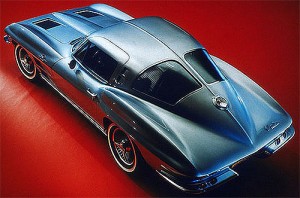 When it came to the Sting Ray, Bill wanted the center crease line that starts at the leading edge of the car’s nose and runs over the hood, roof, and rear deck to be an uninterrupted line, like pressed trousers. Hence, he wanted the line to continue in the split bar that runs through the rear window.
Meanwhile, over in engineering
Pragmatic Zora Arkus-Duntov had a fit when he saw the coupe’s split rear window. From Zora’s perspective of wanting to make the Corvette a driver-friendly racer, the coupe already had a big blind spot at the B-pillar, and the rear window split only made things worse. Both men were very passionate about their ideas. So Duntov went into Mitchell’s inner sanctum and let Bill know how little he thought of Bill’s “pet design element.”
Mitchell was totally infuriated! How DARE a lowly engineer working on a low-volume car come into his turf and criticize HIS design! As Larry Shinoda put it, “It was a real pissing contest.” The rest was history. Mitchell won, Duntov lost. The final compromise was that the first year of the new Sting Ray coupe would HAVE the split-window, then it would go away.
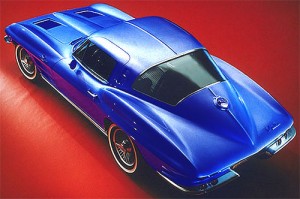 The automotive press sided with Duntov. They all complained about the rear window split. The bar in the middle of the rear window was large enough to hide a Harley-Davidson.
Now, here’s the possible urban legend part…
When the ‘64 Sting Ray came out without the split-window, some 1963 Corvette owners took their coupe to a body shop and had the split CUT OUT the split-window. And the 2-piece rear window replaced with the ‘64 coupe’s rear window and trim. While from today’s perspective, that sounds like one of the Top Five Corvette Sacrileges of all time. But back then, it seemed like something that improved the car.
It wouldn’t be hard to identify such a Corvette. The all-chrome A-pillars and the fake hood grilles were not part of the ’64 Sting Ray Coupe’s body details. This is a Photoshopped version of the about image.
 Car and Driver’s interesting “rumor”
I got to thinking about this. In the April ‘11 cover story of Car and Driver about the upcoming C7 Corvette, there was a little mention of the possibility of the split-window being an “option” on the coupe. Hmmm… now that’s very interesting and could create some unique variations.
So I created a post on this site asking for readers’ opinions. I photoshopped the rear view picture of the Car and Driver-proposed C7 “without” the split window and added a “Cast your vote” feature asking,
“If you were buying a new 2013 C7 Corvette and the ‘Split-Window Coupe’ was an option, would you get one? Check it out HERE.
For a time, the votes were (pardon the pun) split down the middle. But a recent check of the vote count showed that as of 4-7-11…
53% said, “Absolutely – I’d buy one.”
37% said, “No way!”
10% said, “Depends on the price.”
For me, I think it’s kind of cool and if it’s an option, those who want it can have it.
So, here’s my question to you, fellow Corvette enthusiast
Given the above story about the modified ‘63 split-window coupes, have you ever seen or heard of one such ‘63 Sting Ray coupe? Because honestly, aside from that story I read long ago, I do not ever recall reading of or seeing a documented ‘63 Corvette Coupe that had its split-window removed.
I suppose it’s possible that maybe it happened to a handful, because if there were many such cars, you would think that a few would turn up in magazine stories or in auction coverage.
If you know of such a car and can point us in a direction, I would be happy to do a post featuring the car. And then again, it just might be one of the most unusual Corvette urban legends!
Scott

A “classic” urban car legend –
Speaking of urban legends, back in 1973, a friend told me about a guy he worked with whose cousin’s wife’s hairdresser’s brother’s neighbor (<– that’s the first sign of an urban legend) knew where there was a fully functional, running 454 big-block ‘70 Corvette that could be bought for just $1,000!
The reason the car was so cheap was that the owner had died in the car and wasn’t found for weeks!

Since it was summertime when the owner died inside the car, the interior was pretty stinky. And no matter what they did to the car, the stench could NOT BE REMOVED!
Fast forward to the early ‘90s, I was listening to an author on the radio talking about his new book that covered urban legends. In the interview, he told the EXACT same story, only the time period was the early ‘50s and the car was a highly desirable Buick.
Thus proving that often, urban legends never die… they just change with the times.

Corvette Generational History
Our 1953–1962 C1 Corvette Review: Engineering, Styling, Sales, and Legacy Story is now available.
The 1962–1967 C2 Corvette Review: Engineering, Styling, Sales, and Legacy Story is now available.
Also, 1968–1982 C3 Corvette Review: Engineering, Styling, Sales, and Legacy Story is now available.
Click Below for Corvette Model Cars, C1 to C8 Generations