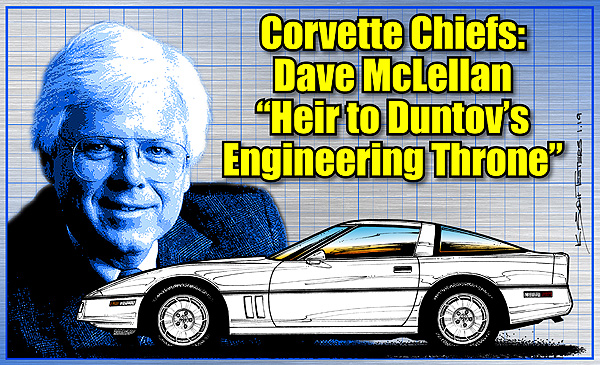
Corvette Chiefs, Pt. 2 of 5 Dave McLellan, Iconic Leadership
Learn how Dave McLellan guided Corvette engineering through decades of evolution — from performance priorities to design breakthroughs — and left a lasting mark on America’s sports car.

Learn how Dave McLellan guided Corvette engineering through decades of evolution — from performance priorities to design breakthroughs — and left a lasting mark on America’s sports car.
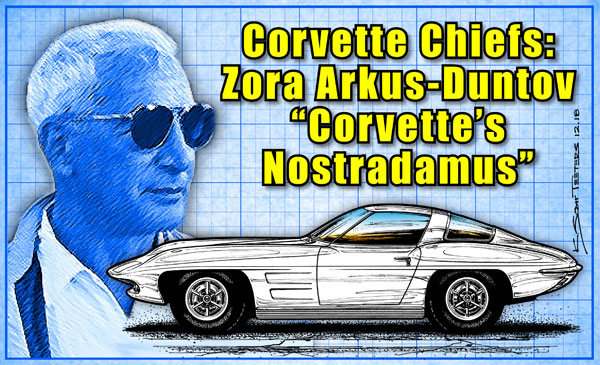
As a young man, Duntov was into boxing, motorcycles, fast cars, and pretty girls. After his formal engineering training in Berlin, Germany, Duntov started racing cars and applying his engineering skills to racecar construction. In 1935 Duntov built his first racecar with help from his racing partner Asia Orley; they called the car, “Arkus”. Their goal was to debut the car at the Grand Prix de Picardie in June 1935. But after a series of mishaps, the car caught fire and never raced. From this point forward, all Duntov wanted to do was build racecars.

After graduating from high school, Perkins took courses at Baylor then served three years in the Navy. After his discharge from the Navy, he took a low-level job, sorting parts at a Chevrolet warehouse, while completing his college courses. With his Navy experience and eventual degree, Perkins quickly rose through the ranks at Chevrolet in Sales & Service. In the mid-‘70s, he landed a peach-of-a-job working for then GM president, Pete Estes. That’s where Perkins learned the ropes of GM corporate life.

I have a very large collection of Corvette magazines and magazine clippings that date back to the late 1950s. Recently I was talking to a Corvette restoration expert about a project that he wants to take on. George is considering building a replica of Zora Arkus-Duntov’s 1969 427 ZL1 development mule.
I’m calling the first wave of PDFs “The Duntov Files”.

Delve into the life and legacy of Harley J. Earl, the visionary automotive designer whose innovation and style helped define the earliest Corvettes and shape America’s most iconic sports car.

My monthly column in VETTE Magazine, “The Illustrated Corvette Series” is now in its 21st year. I’m in the middle of a series I’m calling, “The Corvette’s Founding Fathers” that covers the careers of Harley Earl, Ed Cole, Bill Mitchell, Zora Arkus Duntov, Larry Shinoda, and Peter Brock. Each of these men played a foundational roll in setting the pattern and personality of the Corvette. Without them, the Corvette might not have survived the 1950s.
Scott: Welcome back to Far Out Radio. Joel “Mr. Motion” Rosen and Marty Schorr, the creators of the Baldwin Motion Phase-III supercars of the 1960s and 1970s, are here with us this evening. We’re doing some bench racing and talking about those ground-pounding Chevy supercars from back in the 1960s and 1970s. So Joel, you got the drag racing bug, huh?
Joel: Yea, yea, I got that drag racing bug. One of the things, just to digress just a bit, is that back in the gas station I had, I was one of the first guys with a dynamometer in New York. I was into things like oscilloscopes before people knew what an oscilloscope was – on a car anyway, and I started to teach myself about that stuff. Then a product came out that was a capacitive discharge ignition system, the forerunner of all of the capacitive discharge units, and MSDs and all that. It was an EI-4 and an EI-5, and started to read up on this and the material said that you could run .005 to .006 sparkplug gaps and the engine will run much better and keep it in tune, bla, bla, bla.
What’s not known is if the finished Asteroid was what Nordskog had in mind, or if he handed the new Corvette over to Barris and said, “Customize my Vette.” Custom cars tend to polarize opinions – people love them, or hate them. But from the perspective of 1963, the Asteroid was a hit. Bob Nordskog’s custom/drag Vette won Top Award at the 1963 Long Beach Motorama and the Mickey Thompson Auto Boat Speed Show. There were a few unique factors at work here. First, the Sting Ray was not just new; it looked like nothing else on the road. It was the look of “the future” in 1963. Second, the auto sport of drag racing was really beginning to gain popularity. The beach rock’n rollers, Jan & Dean used a photo of the Asteroid on the back cover of their 1963 album, “Drag City.”