Every C8 Mid-Engine Corvette Indy 500 Pace Car: 2020-2026
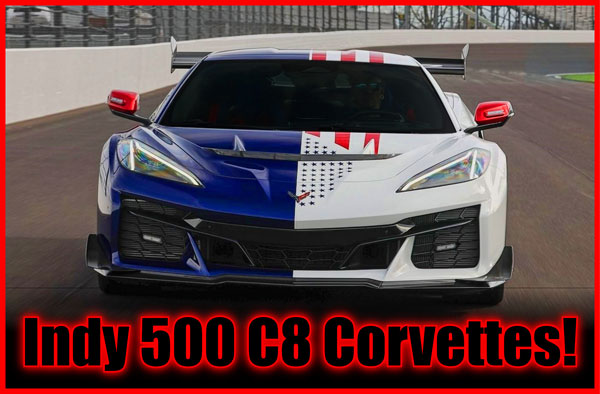
Every C8 Corvette Has Been the Official Indy 500 Pace Car — Here’s the Story
(Photos: https://pacecarregistry.com/ )
A few weeks ago, Chevrolet announced that a 2026 Corvette would once again pace the Indy 500. Oh, another Indy 500 Corvette pace car… yawn… got it. Yes, again. At first glance, it almost seems routine. The thrill should be gone by now. Almost.
The C8 Corvette has paced the Indy 500 every year since the mid-engine Corvette entered production in 2020. But the story goes deeper than that. Corvette also paced the race in 2017, 2018, and 2019. That means America’s sports car has paced the Brickyard classic every year for the last decade.
And there’s more.
Since 1978, Corvette has served as the official Indy 500 Pace Car 23 times. That’s more than any other car in Indy 500 history

Photo: Howard Kirchenbauer
Back in the early years, every Indy pace car received extensive modifications. Yes, they started as production cars, but engineers often upgraded suspension systems, brakes, cooling systems, and horsepower. The cars also received unique paint schemes, graphics, and specialized equipment.
When the 1978 Corvette paced the Indy 500, Chevrolet added a few enhancements, but the car already had the performance credentials needed for the job.
In the 22 Corvette pace car appearances since then, the cars have required very few performance upgrades. Modern Corvettes already deliver supercar-level capability straight from the factory.
Every Indy 500 Pace Car does receive special lighting, communications equipment, and track-control hardware. In 1978, the Corvette pace cars even carried the then-trendy CB radio option. “10-4, good buddy!”
For this report, we’re focusing on the 2020-2026 C8 Corvette Indy 500 Pace Cars. But first, let’s look at why races need pace cars in the first place.
What’s the Point of a Pace Car?
The primary purpose of a pace car is safety and race control. Here’s a basic breakdown of its duties.
At the Start of the Race, the Pace Car:
- Leads the field at a controlled speed
- Keeps the cars in proper formation
- Allows officials to verify that the track is clear
- Prevents drivers from accelerating before the green flag
During the Race, the Pace Car:
- Neutralizes the race during accidents, debris, weather, or track hazards
- Slows the field safely without stopping the event
- Keeps competitors grouped together under caution periods
At the Indy 500, the pace car has become far more than a safety vehicle. Today, it serves as part safety car, part parade vehicle, and part rolling national advertisement.
The Pace Car:
- Introduces the field to the crowd
- Carries celebrity drivers
- Showcases an automaker’s newest performance vehicle
- Serves as a major marketing platform for the manufacturer
How Many Pace Cars Does Indy Use?
Typically, the Indianapolis Motor Speedway receives:
- One official Pace Car for race starts and caution periods
- Several support vehicles, SUVs, and trucks for track operations
- Festival and parade vehicles used during May festivities
Let’s Talk About What a Pace Car Actually Does on Track

At the Indy 500, the pace car leads the field during formation laps before the start of the race or during caution periods.
Cars line up according to their qualifying positions while the pace car maintains a controlled speed of roughly 120 mph. Those laps allow the IndyCars to build tire temperature before the green flag drops.
Official pace car speeds are rarely published. However, manufacturers often take full advantage of their performance cars’ capabilities. That’s why modern Indy pace cars typically use the highest-performance versions of a particular model. Even the base C8 Corvette qualifies as a serious performance machine. The Z06, E-Ray, ZR1, and ZR1X elevate the concept into rolling technology showcases for Chevrolet.
The pace car’s steady 120 mph speed allows the IndyCars to accelerate smoothly as they approach the starter’s stand.
Then comes the moment. The pace car peels into Pit Lane. The starter waves the green flag. And it’s off to the races.
What Other Duties Does the Pace Car Perform?

Besides pacing the field, pace cars handle many practical race-management duties.
Operational Duties Include:
- Track-condition inspections
- Assisting with race restarts
- Serving as an emergency field-control vehicle
- Providing backup communication support
- Managing yellow-flag procedures
- Providing visual cues for drivers
- Supporting safety timing procedures
- Assisting with pit opening and closing sequences
At Indy, the Pace Car Also Serves as the Public Face of the Event

The promotional side of the pace car’s duties includes:
- Television appearances
- Sponsor promotions
- VIP events
- Pre-race ceremonies
- Parade and ceremonial laps
What’s the Fastest Indy 500 Pace Car?
Technically, nobody knows. Pace cars are not officially lap-timed.
Still, modern Corvette pace cars are incredibly fast. The Z06, E-Ray, ZR1, and ZR1X likely peel into the pit lane at speeds between 125 and 140 mph. Unofficial reports claim some Corvette pace cars briefly exceeded 150 mph. They certainly have the capability.
Most modern Corvette pace cars have top speeds above 200 mph. Chevrolet claims the 2026 ZR1X can reach 233 mph.

Here’s a Crazy Corvette Fact
The 2025 Indy 500 Pace Car ZR1 produces 1,062 horsepower. The 2026 ZR1X generates an incredible 1,250 horsepower. Both produce more horsepower than the IndyCars they pace. A modern NTT IndyCar typically delivers between 650 and 700 horsepower. However, horsepower alone doesn’t tell the whole story.
The ZR1 weighs roughly 4,000 pounds and carries a power-to-weight ratio near 3.2:1.
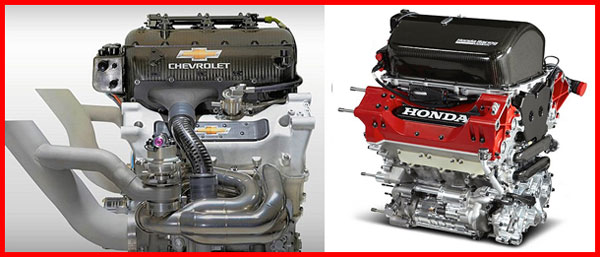
An IndyCar weighs about 1,600 pounds with the driver onboard. With roughly 700 horsepower, the IndyCar’s power-to-weight ratio sits around 2.28:1.
If a ZR1X attempted Indy qualifying laps, the result would not even be close.
IndyCars produce massive aerodynamic downforce, can corner far harder, accelerate faster, and deliver quicker lap times dramatically. Still, the comparison shows how extreme modern performance cars have become.
Let’s put that into perspective.

Johnny Rutherford won the 1976 Indianapolis 500, marking his second victory in this prestigious race. This was the last time the Indy 500 winning car was powered by an Offenhauser engine.
The first Corvette pace car in 1978 used the optional L82 engine rated at 220 horsepower. Chevrolet engineers may have quietly pushed that closer to 250 horsepower.
Meanwhile, the turbocharged Offenhauser Indy engines produced between 700 and 800 horsepower in race trim and nearly 900 horsepower during qualifying.

To see the larger version, click the above image
In 1978, the race cars produced roughly three to four times the horsepower of the Corvette pace car. Today, some Corvette pace cars actually exceed the race cars in raw horsepower.
That’s an astonishing shift in only 48 years. And remember, back in 1978, people claimed performance was dead.
Does the Indy 500 Winner Get the Pace Car? Or is this an automotive urban legend?

It’s one of the most persistent myths in motorsports. “Win the biggest race in America and drive home in the hottest car in America.”
Sounds perfect. But it usually isn’t true.
The myth grew from publicity photos, dealership promotions, replica giveaways, and occasional special gifts. Corvette Pace Car replicas helped fuel the misunderstanding.
Let’s break it down.
Indy 500 winners often pose beside the pace car after the race. Many appear in promotional photos driving the car. Television coverage reinforces the illusion. To the average viewer, it looks like the winner owns the car.
Manufacturers have occasionally awarded vehicles during promotions or dealership events. Sometimes celebrities received special arrangements as well. In 1999, race organizers struggled to secure a celebrity driver for the Chevrolet Monte Carlo pace car.
Jay Leno agreed to drive the car. Instead of receiving a large appearance fee, Leno accepted a low-mileage 1999 Navy Blue Corvette GM demonstrator.
So yes, cars occasionally changed hands. But the actual pace car normally stayed with the manufacturer. During the 1970s and 1980s, pace cars became celebrity vehicles themselves. Media coverage focused heavily on horsepower, graphics packages, celebrity drivers, and replica editions.
Indy winners already receive substantial rewards.
The prize package can include:
- The Borg-Warner Trophy
- Millions in prize money
- Sponsor awards
- Luxury gifts
- Endorsement opportunities
- Manufacturer bonuses
- Licensing deals
- Appearance fees
Still, the “winner gets the pace car” myth refused to die. The idea simply felt believable.
A Fascinating Corvette/Indy 500 Connection from the Beginning

Three-time Indy 500 winner Mauri Rose played an important role in Corvette history. Rose won the Indy 500 in 1941, 1947, and 1948. He worked for Allison Engineering in Indianapolis and raced primarily at Indy. In fact, he competed in the Indy 500 fifteen times and never raced anywhere else.

The 1940s AllisonAllison V-1710-G6 V-12, 1,710 cu. in. was rated at 1,250 HP. @3,200 RPM. The 335.1 cu. in. 2026 ZR1 engine makes 1,064 HP @ 7,000 RPM.
After a serious crash during the 1951 race, the 45-year-old Rose retired from driving. Soon afterward, Chevrolet engineering chief Ed Cole recruited Rose to join the team developing Chevrolet’s new sports car concept — the Corvette.
Rose became one of the hands-on engineers who helped shape the early C1 Corvette. In many ways, racing formed part of the Corvette’s DNA from the very beginning. Corvettes would not become consistent race winners until 1956 and 1957. Thanks to Mauri Rose, Ed Cole, Zora Arkus-Duntov, Smokey Yunick, and others, racing was baked into the Corvette’s DNA.
Mauri Rose Did Quite Well Financially
Rose earned approximately:
- $20,000 for his 1941 Indy victory
- $30,000 for his 1947 Indy victory
- $35,000 for his 1948 Indy victory
Adjusted for inflation, those winnings equal roughly:
- $468,000
- $461,000
- $488,000
Modern Indy winners can earn between $3 million and $5 million once bonuses and endorsements enter the equation. Still, Rose’s winnings were enormous for the era.
In the 1940s:
- Average household income ranged from $1,500 to $2,000
- New homes cost roughly $5,000 to $8,000
- New cars cost about $1,200 to $2,000
Even the U.S. president earned only $75,000 annually. So, Mauri came out smelling like a rose… and gasoline.
So What Happens to Pace Cars After the Race?

As we’ve already established, Indy winners usually do not receive the pace car.
Most pace cars remain with General Motors and become part of GM’s heritage collection or promotional fleet. Many later appear at auto shows, museums, or special events. Some eventually enter private collections.
There have been exceptions.
Occasionally, drivers later purchased the cars themselves. Names associated with former pace cars include:
- A.J. Foyt – January 16, 1935
- Parnelli Jones – 1933-2024
- Emerson Fittipaldi – December 12, 1946
- Bobby Unser – 1934-2021
- Mario Andretti – February 28, 1940
Still, the actual working pace cars, with few exceptions, are still owned by GM. Even when Chevrolet offered Pace Car Replica Corvettes, the customer versions lacked much of the real car’s equipment.
The real pace cars often included:
- Special lighting systems
- Communications hardware
- Integrated electronics
- Safety modifications
- Custom interiors
- Track-management equipment
Federal regulations, certification issues, and inventory tracking also complicated matters.
Why Did Chevrolet Stop Building Pace Car Replica Corvettes After 2008?
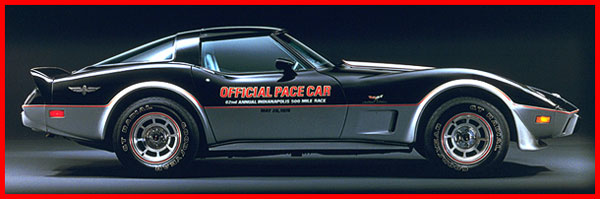
To answer that question, we need to return to 1978. Today, anniversary editions and special packages feel routine. Back then, the Corvette’s 25th anniversary represented something entirely different.
Many people inside General Motors doubted the Corvette’s future. The car offered limited practicality. Production remained relatively low. Some executives considered it uncomfortable, expensive, and unnecessary.
Others wanted Chevrolet to replace the Corvette with a smaller European-style sports car similar to Pontiac’s Banshee concept. What frustrated Corvette critics even more was the car’s growing popularity despite shrinking performance during the emissions era.

Photo: AutoBarnClassicCars.com/
That made the 25th anniversary a major moment for Chevrolet. Originally, Chevrolet planned to build only 300 Pace Car Replicas for customers — matching the original 1953 Corvette production run. Dealers exploded.
At the time, Chevrolet operated roughly 5,000 to 6,000 dealerships.
How could Chevrolet choose which dealers received a 1978 Pace Car Replica? The planned production number jumped repeatedly:
- 300 cars
- Then 1,000
- Then several thousand
- Finally 6,502 cars
Dealers finally received inventory, but exclusivity disappeared. Then things became even crazier. Some dealers doubled or tripled sticker prices. Customers willingly paid massive surcharges, believing the cars would become instant collectibles.
A standard 1978 Corvette Pace Car Replica carried a sticker price of roughly $13,653. Adjusted for inflation, that equals about $72,200 in 2026 dollars. Some buyers reportedly paid the equivalent of over $220,000 in 2026 dollars. What a mess.
The 1986 Corvette Pace Car Replica Took a Different Approach

Because there was no 1983 Corvette, the 30th anniversary quietly passed. Meanwhile, Chevrolet had discontinued Corvette convertibles after 1975. When the C4 debuted in 1984, Chevrolet immediately planned to reintroduce the convertible in 1986. That same year, Chevrolet once again received the opportunity to pace the Indy 500. A yellow 1986 Corvette pace car, driven by General Chuck Yeager, wore simple Indy 500 door decals.
Chevrolet then made an unusual marketing decision. Every 1986 Corvette convertible became an official “pace car replica,” regardless of color. Inside every convertible’s trunk sat a decal package that owners or dealers could apply. As a result, Chevrolet effectively built 7,315 pace car replicas in twelve different colors.
Chevrolet never repeated that strategy.
Production Totals for Corvette Pace Car Replicas
The 1978 Corvette Pace Car was art-directed by GM design chief Bill Mitchell. Designer Randy Wittine created the pace car liveries for the 1995 and 1998 Corvette Pace Cars.
1978: 6,502
1986: 7,315
1995: 527
1998: 1,158
2007: 500
2008: 500
By 2008, the marketplace had changed.
Chevrolet offered numerous special editions, including:
- Anniversary Editions
- Commemorative Editions
- Ron Fellows Editions
- Z06 appearance packages
- Dealer-installed packages
Eventually, “special editions” stopped feeling “special”.
Corvette Buyers Want More Than Graphics Packages Today
In the early years, appearance packages sold extremely well. Today’s Corvette buyers expect meaningful performance upgrades. Since 2001, the C5, C6, C7, and C8 Z06 Corvettes have delivered serious track-ready hardware directly from the factory. The same applies to the Grand Sport, E-Ray, ZR1, and ZR1X models. These are effectively race cars with air conditioning, heated seats, and premium audio systems. Ironically, most never see a racetrack. Still, owners enjoy knowing the capability exists.
“Are those carbon-ceramic brakes?” “Yes, it has Brembos.”
That alone carries enormous bragging rights.
The Final Chapters of the C8 Corvette Story
 Chevrolet has officially confirmed that no additional high-performance C8 variants are coming. What Chevrolet has not said is whether more special editions remain possible. The Corvette’s 75th anniversary arrives in 2028. That could coincide with the final years of C8 production. If the C8 survives beyond 2028 into 2029 or even 2030, Chevrolet will almost certainly celebrate the end of the generation with a major send-off edition. Perhaps the 2027 Indy 500 pace car will become a future Grand SportX. We’ll see.
Corvette insiders remain masters at revealing absolutely nothing before they’re ready. A few years ago, someone asked Harlan Charles during a Michelin Bash event at the National Corvette Museum, “Harlan, we heard there will be a Grand Sport. Can you comment on that?”
Harlan smiled and replied: “Yeah… we heard that too.”
We’ll know when Chevrolet wants us to know.
Below are comparative charts showing the changes and unique features of all seven Corvette Indy 500 Pace Cars from 2020 to 2026.
And if you want more granular details for each of the C8 Indy 500 Pace Cars, we have provided links for each car to the website, www.PaceCarRegistry.com .
Stay tuned.- Scott


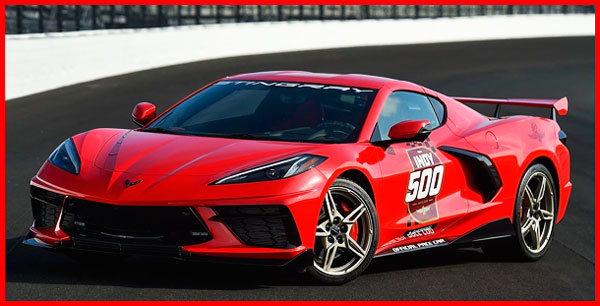
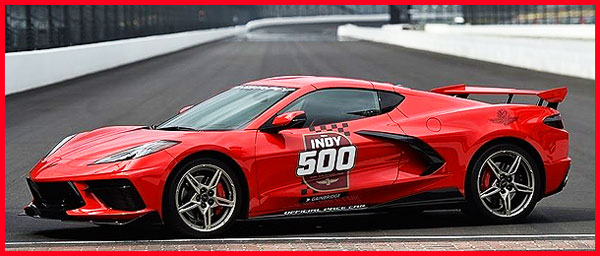 2020 Indy 500 Pace Car – 2020 Stingray Coupe
| Category | 2020 Indy 500 Pace Car |
|---|---|
| Base Model | 2020 Corvette Stingray Coupe |
| Trim Level | 3LT |
| Engine | 6.2L LT2 V8 |
| Horsepower | 495 HP |
| Transmission | 8-Speed Dual-Clutch Automatic |
| Performance Package | Z51 Performance Package |
| Weight | Approx. 3,535 lbs |
| Exterior Color | Torch Red |
| Interior | Jet Black / Adrenaline Red |
| Ground Effects / Aero | Z51 front splitter, Z51 rear spoiler, Carbon Flash accents |
| Unique Livery | Indy 500 door graphics, center racing stripe, official 104th Indy 500 markings |
| 0-60 MPH | 2.9 seconds |
| Top Speed | 184 MPH |
 2021 Indy 500 Pace Car – 2021 Stingray Convertible
| Category | 2021 Indy 500 Pace Car |
|---|---|
| Base Model | 2021 Corvette Stingray Hardtop Convertible |
| Trim Level | 3LT |
| Engine | 6.2L LT2 V8 |
| Horsepower | 495 HP |
| Transmission | 8-Speed Dual-Clutch Automatic |
| Performance Package | Z51 Performance Package |
| Weight | Approx. 3,647 lbs |
| Exterior Color | Arctic White |
| Interior | Sky Cool Gray / Strike Yellow |
| Ground Effects / Aero | Large rear wing, yellow-accent splitter, extended rocker accents, Z51 aero package |
| Unique Livery | Yellow/gray center stripes, Indy 500 door graphics, Stingray decals |
| 0-60 MPH | 2.9 seconds |
| Top Speed | 184 MPH |
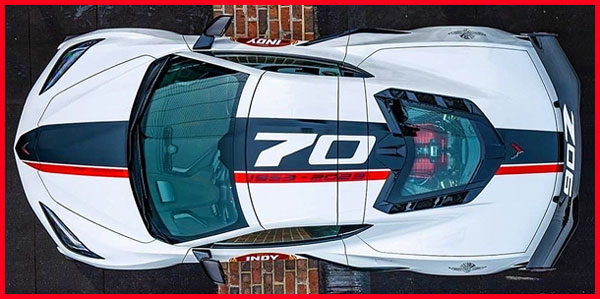 2022 Indy 500 Pace Car – 2023 Z06 70th Anniversary Edition
| Category | 2022 Indy 500 Pace Car |
|---|---|
| Base Model | 2023 Corvette Z06 Hardtop Convertible |
| Trim Level | 3LZ |
| Engine | 5.5L LT6 DOHC Flat-Plane-Crank V8 |
| Horsepower | 670 HP |
| Transmission | 8-Speed Dual-Clutch Automatic |
| Performance Package | Z07 Performance Package |
| Weight | Approx. 3,666 lbs |
| Exterior Color | White Pearl Metallic Tri-Coat |
| Interior | Ceramic Matrix Gray / Black with Red accents |
| Ground Effects / Aero | Carbon-fiber high wing, front splitter, dive planes, rocker extensions, carbon ceramic brakes |
| Unique Livery | Asymmetrical red-and-gray stripes, Indy 500 graphics, 70th Anniversary badging |
| 0-60 MPH | 2.6 seconds |
| Top Speed | 195 MPH |
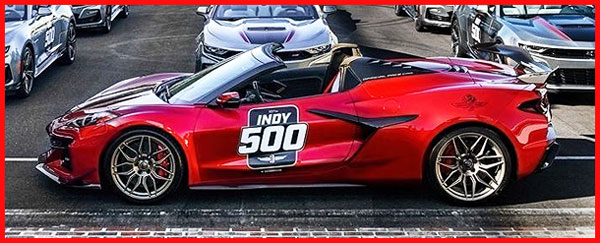 2023 Indy 500 Pace Car – 2003 Z06 Stingray
| Category | 2024 Indy 500 Pace Car |
|---|---|
| Base Model | 2024 Corvette E-Ray Coupe |
| Trim Level | 3LZ |
| Engine | 6.2L LT2 V8 + Front Electric Motor |
| Horsepower | 655 HP Combined |
| Transmission | 8-Speed Dual-Clutch Automatic |
| Performance Package | Standard E-Ray AWD Performance System |
| Weight | Approx. 3,850 lbs |
| Exterior Color | Arctic White |
| Interior | Jet Black / Sky Cool Gray |
| Ground Effects / Aero | Carbon Flash aero trim, wide-body E-Ray package, carbon ceramic brakes |
| Unique Livery | Blue accent graphics, Indy 500 door logos, electrified-themed detailing |
| 0-60 MPH | 2.5 seconds |
| Top Speed | 183 MPH |
 2024 Indy 500 Pace Car – 2024 E-Ray
| Category | 2024 Indy 500 Pace Car |
|---|---|
| Base Model | 2024 Corvette E-Ray Coupe |
| Trim Level | 3LZ |
| Engine | 6.2L LT2 V8 + Front Electric Motor |
| Horsepower | 655 HP Combined |
| Transmission | 8-Speed Dual-Clutch Automatic |
| Performance Package | Standard E-Ray AWD Performance System |
| Weight | Approx. 3,850 lbs |
| Exterior Color | Arctic White |
| Interior | Jet Black / Sky Cool Gray |
| Ground Effects / Aero | Carbon Flash aero trim, wide-body E-Ray package, carbon ceramic brakes |
| Unique Livery | Blue accent graphics, Indy 500 door logos, electrified-themed detailing |
| 0-60 MPH | 2.5 seconds |
| Top Speed | 183 MPH |
 2025 Indy 500 Pace Car – 2025 ZR1
| Category | 2025 Indy 500 Pace Car |
|---|---|
| Base Model | 2025 Corvette ZR1 Coupe |
| Trim Level | 3LZ |
| Engine | 5.5L Twin-Turbo LT7 V8 |
| Horsepower | 1,064 HP |
| Transmission | 8-Speed Dual-Clutch Automatic |
| Performance Package | Carbon Aero Package |
| Weight | Approx. 3,670 lbs |
| Exterior Color | Dark Green Metallic |
| Interior | Jet Black with Green Stitching |
| Ground Effects / Aero | Massive carbon rear wing, carbon dive planes, full carbon aero system |
| Unique Livery | Gold accent stripes, Indy 500 graphics, green/gold heritage-inspired theme |
| 0-60 MPH | Under 2.5 seconds |
| Top Speed | 233 MPH |
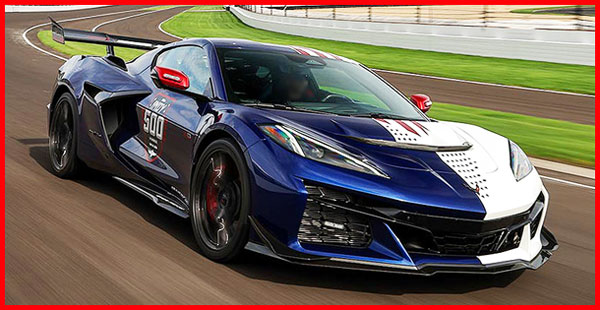
 2026 Indy 500 Pace Car – ZR1X
| Category | 2026 Indy 500 Pace Car |
|---|---|
| Base Model | 2026 Corvette ZR1X Coupe |
| Trim Level | 3LZ Equivalent |
| Engine | 5.5L Twin-Turbo LT7 V8 + Hybrid AWD System |
| Horsepower | 1,250 HP Combined |
| Transmission | 8-Speed Dual-Clutch Automatic |
| Performance Package | ZR1X Performance Package |
| Weight | Approx. 4,000 lbs |
| Exterior Color | Custom Blue-and-White Split Paint Scheme |
| Interior | Jet Black Performance Interior |
| Ground Effects / Aero | Extreme carbon-fiber aero package, large rear wing, dive planes, hybrid cooling aero revisions |
| Unique Livery | Blue driver-side paint, white passenger-side paint, Indy 500 graphics, split-color presentation |
| 0-60 MPH | 1.8 seconds (as reported by Motor Trend in January 2026) |
| Top Speed | Approx. 230-233 MPH |

Corvette Generational History
Our 1953–1962 C1 Corvette Review: Engineering, Styling, Sales, and Legacy Story is now available.
The 1962–1967 C2 Corvette Review: Engineering, Styling, Sales, and Legacy Story is now available.
Also, 1968–1982 C3 Corvette Review: Engineering, Styling, Sales, and Legacy Story is now available.
The 1984-1996 C4 Corvette Review: Engineering, Styling, Sales, and Legacy Story is now available.
You should visit the Corvette Report FREE Public Library today!

Click Below for Corvette Model Cars, C1 to C8 Generations