March 1968: Mid-Engine Astro-II Debut, Another Gamble

Another mid-engine Corvette concept car stokes Corvette fans
Almost from the beginning, racing made the Corvette a living legend. Sports car development exploded in the 1960s. At the cutting edge were the Ford GT40 and the Chevrolet-backed Chaparral, both built around a mid-engine layout.
The Astro II (XP-880) became the first of several experimental mid-engine Corvettes and kicked off years of exotic sports car anticipation.

This was Chevrolet R&D Chief Frank Winchell’s mid-engine Corvette
Zora Arkus-Duntov gets most of the attention for pushing a mid-engine Corvette. But he wasn’t alone. Chevrolet R&D chief engineer Frank Winchell also believed in the concept. Winchell worked closely with Texan Jim Hall and valued access to Hall’s private Rattlesnake Raceway in rural Texas.
Ford fired the first shot. They offered a street version of the GT40, called the Mark III, and unveiled the Mach 2 experimental mid-engine car in May 1967. Chevrolet designers responded immediately and began work on their own mid-engine Corvette.
Just 11 months later, they revealed the Astro II. The car triggered a wave of speculation and raised the obvious question: Is this the next Corvette?
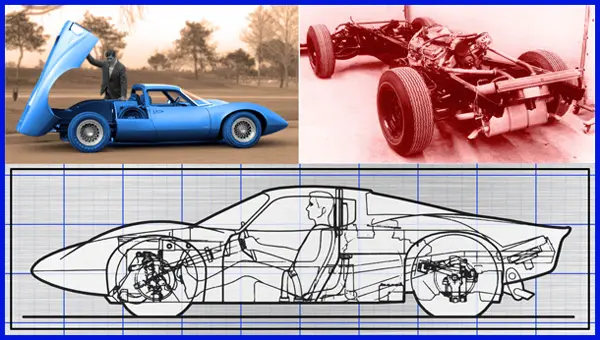
“Parts bin”, yes, but that’s how concept cars were made back then
By using off-the-shelf components, the team moved quickly and kept costs down. But Chevrolet never fully committed to the project. The Astro II used an out-of-production 1963 Pontiac Tempest two-speed automatic transaxle.
Ford, by contrast, had a race-proven four-speed manual gearbox for the Mach 2. That raised a serious concern. If Chevrolet pushed this car into production, would enthusiasts accept a two-speed automatic Corvette? Probably not.
Even with that weakness, Winchell’s Astro II was a fascinating effort. The car looked exotic and unmistakably Corvette. It used a central backbone frame with thick doors that housed safety beams. Engineers placed a 20-gallon fuel cell in the center of the chassis. The engine, suspension, and drivetrain are all mounted to that central structure.

A Corvette with Can-Am flavor
With a 427 big-block, the Astro II felt more like a Can-Am racer than a street car. Even with production Camaro and Corvette suspension parts and street tires, the car generated 1.0 g of cornering grip. That was the magic of a mid-engine layout.
The Astro II weighed about 3,300 pounds—roughly 300 pounds less than a production Corvette—yet kept nearly identical exterior dimensions.
Keep in mind, concept cars aren’t real production machines. Designers often overreach and leave out practical details. The Astro II had no headlights, turn signals, windshield wipers, front and rear bumpers, or a spare tire. The tilt-up rear section is cool for race cars, but not realistic for a production car. Note the “sugar scoop” roof section that’s similar to the 1968-1977 Corvette.
The two-speed automatic transaxle alone doomed any production hopes. The 1961–1963 Tempest unit was designed for a 194-cubic-inch slant-four engine. It worked for a concept, but it would never survive behind a big-block.
While the Astro II underwent track testing in spring 1968, Duntov and his team worked on their own solution—the striking XP-882. Duntov turned to the three-speed automatic transaxle from the Oldsmobile Toronado. His design even earned a U.S. patent.
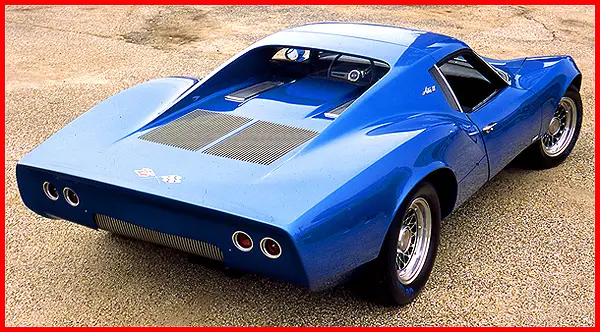 But it was extremely complex. GM would never approve the cost to produce it.
By the mid-to-late 1970s, “downsizing” became Detroit’s new mantra. Two Arab Oil Embargoes turned the industry upside down, and “boxy” styling took over.
There was a silver lining. The shift forced GM and others to finally develop transaxles for mass production. That idea dated back to Chevrolet engineering chief Ed Cole and his proposed “Q-Chevrolet” program.
Cole believed transaxles could free up interior space and improve weight distribution by placing more mass over the rear wheels. It was a bold vision.
But only a few GM cars—like the Corvair, Olds F85, and Buick Skylark—used transaxles at the time.
GM didn’t approve a serious manual transaxle program until the early 1990s, when the C5 Corvette platform finally moved forward.
But overall, for a shape designed in the mid-1960s (60 years ago!), the 1968 Astro-II still looks great!
Sometimes, great ideas arrive decades before the world is ready for them. – Scott


Corvette Generational History
Our 1953–1962 C1 Corvette Review: Engineering, Styling, Sales, and Legacy Story is now available.
The 1962–1967 C2 Corvette Review: Engineering, Styling, Sales, and Legacy Story is now available.
Also, 1968–1982 C3 Corvette Review: Engineering, Styling, Sales, and Legacy Story is now available.
Click Below for Corvette Model Cars, C1 to C8 Generations