Mike Moss Team Zora 1957 Fuelie Mille Miglia Corvette
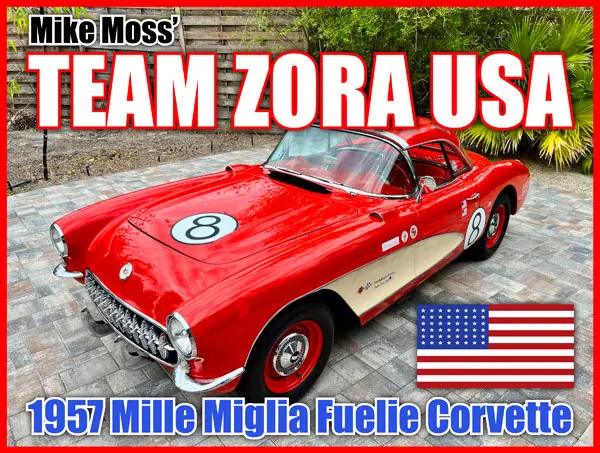
A 1957 Fuelie Takes On The Most Beautiful Rally Race Ever
This story first appeared in the December 2025 issue of Vette Vues Magazine.
Dateline: 3-7-26 – Before you turn the page thinking, “Another Venetian Red Corvette race car…,” hold on.
There’s much more to this story. Sarasota, Florida, resident Mike Moss’s perfectly restored 1957 283 Fuelie—with all the then-new “Racer Kit” RPO 684 Heavy Duty Racing Suspension options—has roots that trace back to 1927 in Italy.
But before we travel nearly a century back, we need to see how the fifth-year Corvette evolved from a mild 150-horsepower six-cylinder with a 2-speed automatic sporty car into a 283-horsepower, fuel-injected 283-cubic-inch serious sports car backed by a new 4-speed manual, full-race suspension, and upgraded brakes and steering.

A Weak Start Is Better Than No Start At All
For too long, many people have dismissed Chevy’s 1953-1954 Corvette as a half-hearted effort by a company unsure of itself. That’s a mistake.
When the first 1953 Corvettes rolled off the Flint, Michigan, assembly line on June 30, 1953, Chevrolet engineers were already developing the all-new 265 small-block V8 that would debut in the fall of 1954 for the 1955 model year. The first Corvette arrived only fifteen months ahead of that milestone engine.
Suspension chief Maurice Olley and Indy 500 winner Mauri Rose designed the Corvette’s frame and suspension, knowing V8 power was coming. Harley Earl brought the styling vision, while Ed Cole—Chevrolet’s engineering dynamo—knew the Corvette needed more than good looks. It needed muscle and racing credibility. Cole hired Rose and racing engineer Zora Arkus-Duntov to make that happen.
When Duntov secured a pre-production 265 for a 1954 test mule Corvette, the real transformation began. In December 1955, his modified car reached 156 mph at GM’s Arizona test track. From that moment, Corvette’s destiny as a true American sports car moved forward.

The 1957 Version of the Modern Z51 Corvette
The first target was Daytona Beach for speed records, then the 1956 12 Hours of Sebring. With Smokey Yunick’s “Best Damn Garage in Town” based in Daytona—and already helping Ed Cole make 265 Chevys competitive in Stock Car racing—Cole’s A-Team turned to Smokey for “field development.”
Meanwhile, several key pieces fell into place. Duntov oversaw the development of the new Rochester fuel-injection system for the 1957 Corvette. Engineers enlarged the small-block to 283 cubic inches, prepared a stout four-speed manual transmission, and upgraded the suspension and brakes to racing standards.

Corvette Generational History
Our 1953–1962 C1 Corvette Review: Engineering, Styling, Sales, and Legacy Story is now available.
Duntov led the engineering effort that became the “Racer Kit,” while Mauri Rose worked closely with Yunick in the field. Smokey, rarely generous with praise, said of Rose:
“He was a hard-working, sharp, ‘run to win or bust’ sort of cat… a racer first, Chevy engineer second. If racers ranked from privates to generals, Mauri would have been a five-star.”
As Chevrolet released racing parts for Stock Cars and Corvettes, racers borrowed the parts and later returned them for evaluation, laying the groundwork for Chevy’s RPO performance program for 1957. Unlike modern Z06 models, Chevrolet never marketed the Racer Kit; you had to know which options to order, and it wasn’t cheap.

Corvettes had always been premium cars
The 1957 base model cost $3,176, compared to $1,885 for a basic Chevy 2-door sedan. The fully equipped “racer” Corvette required the following options:
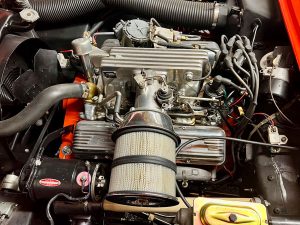
RPO 579D “Airbox” 283 Fuelie with 283 horsepower. Chevrolet built only 43 Airbox Fuelies. Most Fuelie Corvette racecars did not use the airbox.
- 1 – RPO 677, 678, or 679 Positraction rear with 3.70:1, 4.11:1, or 4.56:1 gearing.
- 2 – RPO 683 4-speed manual transmission.
- 3 – RPO 684 Heavy Duty Racing Suspension.–
 The total bill came to just under $5,000. In 2025 dollars, that equals roughly $59,000. When Chevrolet introduced the 2020 mid-engine C8, the base price was $59,995. In 1957, if racing was your intended purpose, $5,000—plus preparation—could buy a capable Corvette ready to race.
By the end of the 1950s, “Racer Kit” Corvettes were dominating SCCA racing. On May 19th, 1957, three 1957 Fuel Injection customer racecars driven by Dr. Dick Thompson, Carroll Shelby, and Bill Howe Jr. finished First, Second and Third, respectively, at the SCCA Regional at Cumberland, MD.
One week later, at the SCCA Nationals at Elkhart Lake, WI, four B/Production Corvettes, led by Jim Jeffords, finished 1-2-3-4! Dick Thompson and his Fuel Injection 1957 Corvette went on to win SCCA’s coveted National Champion honors in 1957.
Meet Me In Rural Italy For The Mille Miglia!

A century ago, road racing attracted royalty and the wealthy. Italian Counts Francesco Mazzotti and Aymo Maggi launched the first Mille Miglia in 1927 — “Mille Miglia” meaning “thousand miles.”
There was no “track”; the 1,000-mile race ran on public roads from Brescia to Rome and back in a figure-eight route. Drivers raced unmodified grand touring cars at high speed on rural roads, which made the event extremely dangerous.

Marketed as “the most beautiful race in the world,” the inaugural event began on March 27, 1927. Seventy-seven cars started the race; Giuseppe Morandi won in an Officine Meccaniche (OM) Tipo 665 “Superba.” OM, already successful at Le Mans in 1925–1926, swept the top three positions. Morandi averaged 48.27 mph.
In contrast, Sir Stirling Moss averaged over 97 mph when he won the 1955 Mille Miglia in a Mercedes-Benz 300 SLR—a stunning leap in speed in just three decades.

From 1927 to 1957, organizers ran the Mille Miglia 27 times
Safety was primitive: drivers wore no helmets or seat belts, guardrails did not exist, and spectators stood within arm’s reach of the speeding cars. During that period, 56 people died — 32 spectators and 24 drivers.
The 1955 Le Mans tragedy underscored the risks of the era when Pierre Levegh’s Mercedes-Benz crash killed 84 spectators.
The Mille Miglia ended in 1957 after two fatal crashes, including the Ferrari 335 S accident that killed Alfonso de Portago, co-driver Edmund Nelson, and nine spectators. Authorities later charged Enzo Ferrari with manslaughter, but a court acquitted him in 1961 after investigators blamed a broken metal road marker.
From 1958 to 1961, organizers continued the event only as a regulated rally before ending it entirely. They revived the Mille Miglia in 1982 as a vintage rally, and since then, only one fatality has occurred, 77-year-old Harlan Schwartz in a 1932 Alfa Romeo in 2004.

Meet Mike Moss, owner of the Team Zora 1957 283 Fuelie Corvette
Mike Moss grew up in Bucks County, Pennsylvania, with a passion for both drag racing and road racing—eventually favoring sports car road racing. He built a successful international trading business that took him across Asia, the Middle East, and Africa for 35 years.
By 2010, he was able to manage operations from the U.S., giving lectures at the Naval War College and Naval Academy and devoting more time to vintage racing in the SVRA Series.
 “In the mid-2000s,” Mike recalls, “I bought a 1965 Corvette Roadster and began vintage sports car racing.” Nearby, a shop housed one of the four DeAtley 1984 Trans-Am Corvettes. DeAtley, who had campaigned 1983 Camaros, was asked by GM to field the new 1984 C4 Corvette in Trans-Am competition. These were full tube-frame racers with lightweight, widened bodies—far from showroom stock.
Mike later purchased and raced one of the DeAtley cars. Though over 20 years old, it remained a working race machine. His first event with it at Watkins Glen ended in a mishap that led to a meticulous five-year restoration by Scott Michael and Tony Fernandez in Easton, Pennsylvania. “It’s immaculately restored,” Mike says. “I didn’t want to see it go back on track.” In 2020, he donated the car to the National Corvette Museum.
His enthusiasm extends beyond Corvettes—he’s owned a Lola T-70 Mk III B, a Lola T-163 Can-Am (driven by Peter Revson), the Gordon Johncock 1966 Gerhardt Indy car, and a 1969 Gurney Eagle Indy car once driven by Denny Hulme.
 When Car Guys Get Together, They Talk
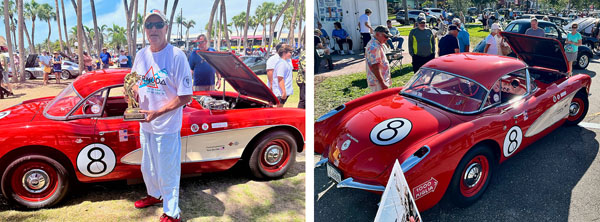
If you’re an old car guy and into Corvettes, you likely know the name, Marty Schorr. In the 1960s and early ’70s, Marty was editor of Hi-Performance CARS magazine. From 1967 to 1974, he handled branding, advertising, and marketing while Joel Rosen built the Baldwin-Motion Supercars—Joel spun the wrenches, and Marty spun the spin.
In 1976, Marty launched the first regular-frequency Corvette-only newsstand magazine, VETTE Quarterly, later changing the title to VETTE. He left VETTE in 1982 to start Performance Media Public Relations (PMPR, Inc) and publish books under the Quicksilver Supercar Series imprint. His first Corvette-related book was CORVETTE From Six to Stingray in 1976. VETTE grew into a monthly publication that ran until December 2019.
After semi-retiring to Sarasota, Florida, Marty started a car guy lunch group with a “handful of certifiable car crazies” in 2003 who met for burgers and bench racing. A year later, the Sarasota Café Racers were born with the slogan, “Car Guys Who Lunch.” The group meets every two weeks and now has chapters in New Jersey, Washington, DC, Connecticut, Tampa Bay, Ontario, Iran, Pakistan, and Germany.
It all came together over lunch

Left: Mike Moss, Right: Marty Schorr
One day, while Mike Moss was having lunch with Marty, the topic of Italy’s Mille Miglia came up. The last true race ran in 1957—the same year Duntov’s team created the first Corvette with available options specifically created for road racing: The solid-lifter-cammed 283/283 Corvette engine with Rochester Fuel Injection, and a full complement of RPO Heavy Duty Racing options.
While the Mille Miglia accepted production GT and sports cars, no one had entered a Corvette before. The modern rally allows only production car brands from 1927 to 1957 that have participated in the original events. That left Corvette out until the 1000 Miglia organization created a special class (Guest List category) for cars of historical/sporting significance and “historical continuity”.
The 1953-1957 Corvette and 1955-1957 two-seat Thunderbirds qualify. TEAM ZORA USA’s 2026 Mille Miglia entry: 1957 Corvette Fuelie with RPO-579C 283/283 engine, Sebring dual filter air cleaner, and RPO competition suspension, steering, and brake equipment has been prepared for endurance racing as a new Corvette would have been prepared for road racing by a factory-supported team in 1957.
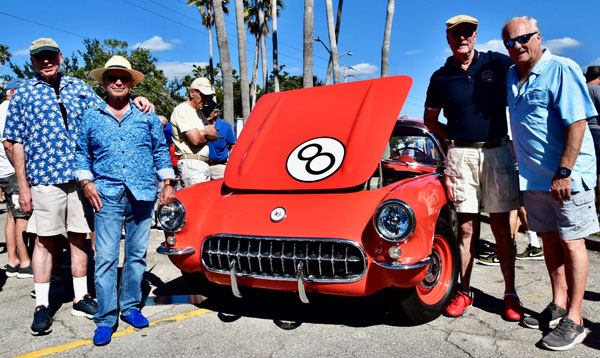
Meet the Members of “TEAM ZORA USA”
TEAM ZORA USA was founded in Sarasota, Florida, by Michael D. “Mike” Moss and Marty Schorr for the express purpose of honoring the legacy Corvette Godfather, Zora Arkus-Duntov, and celebrating America’s Sports Car. Mike is the owner & driver; Marty is the Chief Communications Officer. Other team members include:
- John Cutrone, Sarasota, Florida: Hospitality, Logistics Manager and Cultural Attaché to Italian Food & Wine Festivals.
- Ken Kayser, Englewood, Florida: Retired GM engineer, Corvette Racing Historian, author, and Rochester Fuel Injection expert.
- Bud Bennett, Brighton, Michigan: Co-Driver/Navigator, General Manager, and Managing Partner at RM Motorsports, Wixom, Michigan.
- Tony Pardo, Northville, Michigan: RM Motorsports GM, endurance racing preparation.
- Larry Ligas, Largo, Florida: Co-Driver/Navigator, and owner of Predator Performance Racing.
- Jacob Angel, Bainbridge Island, Washington: Teammate, Western States Corvette racer, and owner of Dave MacDonald’s 1960 Fuelie Corvette racecar.
- Larry Webb, Seattle, Washington: Corvette Whisperer and Race-Prep & Tech Advisor consulting with RM Motorsports.
- Dave Rider, Bethlehem, Pennsylvania: TEAM ZORA USA livery designer and co-owner, and graphic designer at Rider Graphix.
 Finding a Reasonably Complete 1957 Fuelie
Before the project could begin, the team had to locate a four-speed 1957 Corvette Fuelie. Chevrolet built 1,040 Corvettes that year with the RPO 579 FI engine, and finding a quality example proved not to be that difficult — Mike found one nearby.
The car, located in Florida, had spent years in Maryland, where it was both drag raced and road raced. When Mike bought it, the car was tired but complete, still wearing traction bars from its drag racing days.

It was born as a Venetian Red (with Shoreline Beige coves, dashboard, and interior trim) Fuelie in the St. Louis, Missouri Corvette assembly Plant on Tuesday, June 25, 1957, months after FI engines and four-speed transmissions started being installed in new Corvettes. The block, heads, and FI have correct date-coded casting numbers.
RM Motorsports of Wixom, Michigan—renowned for racing preparation, race team support, prototyping, and restoration—was contracted to return the ’57 Fuelie to factory competition specs as it would have been road-raced at Sebring by factory-supported racers in 1957.
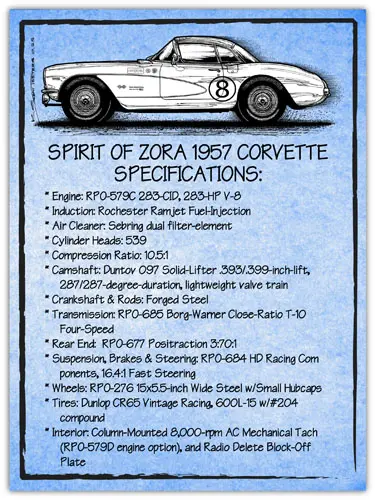 The restored car is exactly as it would have been ordered new for road racing in 1957, featuring an RPO-579C 283/283 engine, fuel injection, and dated castings. Its “Sebring” dual filter air cleaner is an authentic reproduction of the competition air cleaner used on the factory-supported Corvettes racing at Sebring in 1957.
The full RPO 684 Heavy-Duty Racing Suspension and brake system was installed, including upgraded springs, shocks, sway bar, quick-steering adapter, metallic brake linings, finned drums, and rear brake ducts with “elephant ear” scoops. The 283/283 RPO 579C engine, 4-speed transmission, and 3.70:1 positraction were also fully restored.

Meet Mike Moss’s “Uncle Sterling”
Did you notice Mike’s last name, “Moss”? If you’re into sports car history, that should ring a bell — as in Sir Stirling Moss, the legendary international racing champion.
While Stirling Moss’ career is too vast to summarize here, a few threads connect him with our Mille Miglia Mike Moss and his 1957 Fuelie Corvette.

In 1955, Stirling Moss and navigator Denis Jenkinson won the Mille Miglia in a Mercedes-Benz 300 SLR. The weather was perfect, and they completed the 1,000-mile race in 10 hours, 7 minutes, 48 seconds — averaging 99 mph. On rural stretches, they topped 190 mph, flying 200 feet through the air at one crest. Fangio finished second in another 300 SLR, 32 minutes behind.
The second link came at the 1957 12 Hours of Sebring, where Chevrolet debuted the Corvette SS. Moss test-drove the rough development “mule” car while John Fitch raced the finished version. The magnesium body and upswept headers turned the cockpit into an oven, and the car retired after 23 laps. That same chassis later became Bill Mitchell’s 1959 Stingray Racer, which won the 1960 C/Modified Championship.
Decades later, as Mike Moss’ racing career gained momentum, he contacted Sir Stirling. After several friendly exchanges, they concluded they were “thinly” related. Mike called him “Uncle Stirling,” and Stirling called him “my nephew, Mike.” Both enjoyed the connection — however distant.
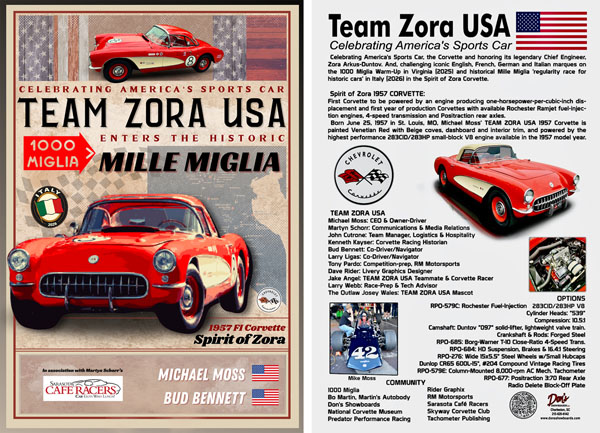
What’s Next For Mike Moss and the Team Zora USA 1957 Fuelie Corvette?
The Mille Miglia is no longer a true “race” but a four-day rally, with cars restricted to posted speed limits except for a few open sections. It’s as much a rolling car show as a rally, limited to production cars from 1927–1957. Although no Corvette competed in the original Mille Miglia (1954–1957), organizers now allow Corvettes up to 1957 to enter. The 1957 283 Fuel Injected Corvette, equipped with its factory racing parts, qualifies as a “production” entry. Since 1982, when Mille Miglia was revived as a vintage rally, Corvettes have competed in the event.

Mike Moss has entered his 1957 Fuelie in the 2026 Mille Miglia, making it the first Corvette to participate. Asked about his Bucket List, Mike said, “Absolutely! I’m an adventurer, and just being part of the Mille Miglia is one of the ultimate experiences for an amateur. It’s about the history, excitement, passion, and the semi-celebrity.”
Also on his list: the HSR Classic 24 at Daytona, Classic 12 at Sebring, and Classic 6 at Watkins Glen. A determined international businessman, Mike Moss, will surely check them all off. – Scott

Corvette Generational History
Our 1953–1962 C1 Corvette Review: Engineering, Styling, Sales, and Legacy Story is now available.
This story first appeared in the December 2025 issue of Vette Vues Magazine.

Click Below for Corvette Model Cars, C1 to C8 Generations