Corvette Timeline Tails: Happy 102nd Birthday Zora Arkus-Duntov
Dateline: 12.25.11
Where the Corvette Got Its Mojo From!
Don’t miss the Duntov video at the bottom of this post!
Corvettes are all about passion and that passion shows up in two powerful ways – visually and from performance. The two are so intrinsically connected that they seem one and the same, but a closer examination reveals that is not the case. Of course, the first thing one notices about the Corvette is its looks. The car’s appearance is totally unique, even though it did borrow a little here and there from other designs. But at the end of the day, the completed design only looks like a Corvette.
But looks will only get you so far. What completes the Corvette addiction is the visceral experience of driving one. To “get” the Corvette, you must drive the car. And if the driving experience was now much different from a mushy sedan, what’s the point? No, if the Corvette didn’t deliver responsive performance with gobs of sensory input for the driver, the car surely would have gone quietly into the night, fading into automotive obscurity, along with a long list of once interesting cars.
So who was responsible for infusing the Corvette with it’s Mojo? Zora Arkus-Duntov. Zora was, without a doubt, the ultimate automotive corporate misfit to ever work in Detroit. By the time he saw the very first Corvette at the 1953 Motorama, he was 44 years old, a seasoned mechanical engineer, race car driver and builder. he was quoted as saying, “When I saw the Corvette at the Motorama, I thought it was the most beautiful car I’d ever seen.” And Duntov appreciated beauty. Just look at his stunning blond beauty wife and former Bluebell Girls dancer, Elfie Duntov. yes, Zora new a good-looking dame when he saw one and one look at the Corvette and he knew where he wanted to be – in the engineering department of Chevrolet, working on the Corvette. Continue reading
Zora Arkus-Duntov’s Mule Corvettes – Zora’s Toys
Dateline: 12.24.11
While Zora never got a custom Corvette, he still had some very cool Corvette toys!
Zora Arkus-Duntov Birthday Weekend continues here at CorvetteReport.com. Over the last few months we told you about several of the customized Corvettes that were built for Chevrolet executives. But to the best of my knowing, the man that found the Corvette’s Mojo never got a full-out Chevrolet styling department customized Corvette. He did buy a ‘74 Corvette coupe upon his retirement and by all accounts it didn’t have any performance enhancements, but it did get a unique stripe paint job.
So, Why didn’t Duntov get a custom Corvette? Maybe he wasn’t high enough up on in the GM corporate food chain. We’ll probably never know. Not that Zora didn’t have his toys. Zora’s Corvette toys were often all-out racing optioned Corvettes. Along the way of developing his various “racer kit” packages,he built an interesting array of mule Corvettes. These were cobbled together cars that were never taken out of the Chevrolet R&D center or test track.
I covered Duntov’s mules in a two-part story in my VETTE Magazine Continue reading
The John & Burt Greenwood BF Goodrich Trifecta at Corvette Repair
Dateline: 12.19.11
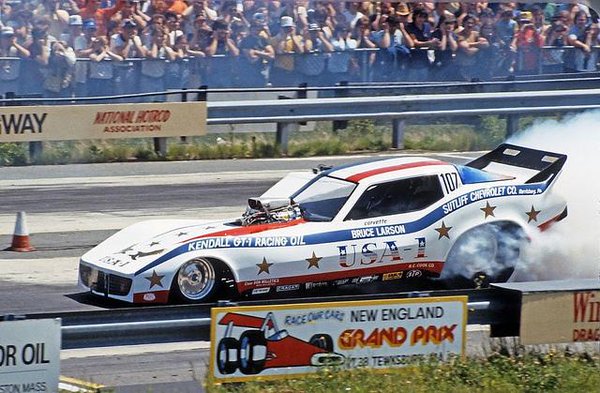
Mega Horsepower! Racing on Street Tires! And Blazing Stars & Stripes!
(Check out the slide show at the bottom of this post.)
Here’s a sweet little bench racing, Corvette day dream for ya! Imagine if you have a Corvette restoration shop and you had ALL THREE Greenwood BF Goodrich Corvette race cars in for restoration work. Yes, I know – open headered, old-school, hard-ass Corvette racing machines. Could you stand it? Well, Kevin Mackay and the Corvette Repair team could and it was no bench racing fantasy.
Mackay’s Valley Stream, New York shop has been doing top level C1, C2, and C3 Corvette restoration work on production Corvettes for over 25 years and has developed a nitch for Corvette race car restoration work. Kevin and his team of craftsmen have brought back to life some of the most famous early model Corvette race cars and Chevrolet Engineering experimentals to ever wear a set of Corvette cross flags. It’s not uncommon for race cars to be thoroughly beat when a team decides to unload a machine. Once gone, most teams rarely if ever keep track of the car’s new owners. So, part of what makes Corvette Repair’s work so interesting is the car’s back story of what happened after a high-profile team sold the old war horse off. Some are well maintained and enjoyed on the track. Some are even converted BACK to street cars, such as the Cunningham Le Mans class-winning 1960 Corvette. And others aren’t so fortunate and are pretty much are one hoof away from the glue factory. Continue reading
Corvette Timeline Tales: Happy 72nd Birthday to Dick Smothers
Dateline: 11.20.11
Dick Smothers – The 200-MPH Comedian
(Check out the fun videos at the bottom of this post!)
How many comedians can claim that they drove a 427 Corvette over 200-MPH at Le Mans? Probably none, except for Dick Smothers. If you are a baby boomer and were watching TV in the ‘60s, hardly a week went by when you didn’t see Tom and Dick Smothers on the tube. In the early ‘60s with the advent of 33-1/3 LP records (long-play vinyl records with five or six tracks on each side) nearly all comedians had comedy records. Some people (myself included) had collections of comedy albums that were fun to play at parties.
But the Smothers Brothers were a little different. While the comedy team format was common (Hope & Crosby, Burns & Allen, Martin & Lewis, Burns & Carlin (George), what made The Smothers Brothers different was that they were also folk singers, aka ‘Folkies.” Tom played guitar, Dick played a full-size bass, and they were dressed in matching suits with skinny ties. And when they weren’t jabbing at one another and just sang, that were quite nice and covered the standard folkie songs of the day. Their 1962 album “The Two Sides of the Smothers brothers” featured sweet songs, such as “Stella’s Got a New Dress Today” (see below video) on one side and comedy bits including as “I Fell In A Vat of Chocolate.” (see below video)
But it was their late ‘60s TV show, “The Smothers Brothers Comedy Hour” that polarized them to mainstream Americans because of their jabs and pokes at President Nixon and the Vietnam War. Their comedy program is available on NetFlix and in retrospect, compared to modern comics, such as Jon Steward and Bill Maher, Tommy and Dicky were VERY tame.
The Great 454 ZL-1 1969 10-Second Monster Corvette Pumpkin!
Dateline: 10.31.11
December ’69 Motor Trend reports on Chevy’s 10-second, 454 ZL-1 Monster Pumpkin Corvette!
Forty years ago it took a lot to get a car to run 10s in the quarter-mile. You needed a BIG engine, open tuned headers, a giant gas sucking Holley carb, slicks, ear plugs, and a lot of NERVE! Today, it’s no biggie for a performance car to run low 11’s. Lingenfelter Engineering has been able to get a mildly modified ZR1 to run low-to-mid 9s with ALL of the stock creature comforts. All you have to do is HOLD ON!
No, back in the old muscle car dayz, low 11s and high 10s in the quarter-mile was Super Stocker and Modified Production territory. Low 10s and 9s was the realm of Pro Stockers with the likes of Grumpy Jenkins, Sox & Martin, Dick Landy, Dyno Don Nicholson and a few dozen others. In their day, they were the rock stars of drag racing.
When the December 1968 issue of Hot Rod Magazine hit the news stands, with a full-cover shot of the all-aluminum 427 ZL-1 engine, heads spun like Linda Blair in The Exorcist! The headline at the top of the cover read, “A 625-HP LOOK AT: CHEVY’S ALL-ALUMINUM 427.” While today we might say, “There’s no substitute for a supercharger,” back then, the expression was “There’s no substitute for cubic-inches. If there’s enough meat left in the block, just bore it out and insert bigger pistons. Chevy’s 427 had been in production since ‘66, so when the ‘70 models came around, what was Chevrolet to do? Bore, Baby, Bore!
The cast iron 454 was a no-brainer, but what about the all-aluminum ZL-1? Just to see what kind of response they’d get from the press (as if they weren’t sure) Chevrolet engineers Tom Langdon and Gib Hufstader built a special 454 version of the ZL-1, coupled it with a Turbo 400 3-speed tranny, a high-stall torque converter, tall gears, and 9-inch slicks. Yes, it was a quasi-Super Stocker and they let the automotive press make passes on a 1/4-mile stretch at the test track!
Illustrated Corvette Series No. 175 – Greenwood Stars & Strips Goes On The Block!
Dateline: 10.30.11
Here’s the latest installment from the Illustrated Corvette Series VETTE Magazine Column
(Check out the Greenwood video at the bottom of this post!)
It was early last July that Kevin Mackay of Corvette Repair sent me a link to the RM Auctions online version of their Monterey Auction Catalog. Kevin and I have had many conversations about early Corvette race cars, so he knows that I’m a big fan. Any time a Greenwood Corvette goes on the block it’s big news, so I posted a story about the auction right away. For the next 6 weeks or so, the car magazine and Corvette blogs were on fire in anticipation of the auction. RM Auctions broadcasts their auctions online, so I stayed up and watched the coverage and sale of the Greenwood ZL-1. I have to admit, it was a lot of fun. Here’s the post of the auction coverage.
Since the car has so much historical importance, I decided to cover the car in my VETTE Magazine monthly column, “The Illustrated Corvette Series.” The January 2012 issue of VETTE just came out, so I’m sharing the story and art with you below. Enjoy! – Scott
Illustrated Corvette Series No. 175: #49 Greenwood ‘69 427 ZL-1 Racer
“Stars and Stripes On The Block!”
Expectations were high when it was announced that the No. 49 Greenwood BF Goodrich “Stars and Stripes” Corvette was going on the block at the 2011 RM Auction Monterey event. Some estimated that the car would sell for $750,000 to $950,000. In ‘09 the Gulf One ‘63 Z06 Corvette racer went for an astonishing $1.113 Million! So there was quite a buzz in the Corvette community.
John and Burt Greenwood knew all about Duntov’s “racer kits” and like many others, took maximum advantage of the special hardware. The Greenwood boys had another advantage. Sr. Greenwood had been a WW II fighter pilot and worked at the GM Tech Center. Their Dad would sometimes take young John and Burt to work on Saturdays, to let the lads see the experimentals and prototypes. It was better than an invitation to Elvis’ house! Continue reading
Corvettes Unlimited of Vineland New Jersey’s Glass & Steel Show
Dateline: 10.26.11 (This is our 200th post!)
Corvette & Classic Car Autumn Fun in New Jersey
(Check out to six slide shows at the bottom of this post!)
Autumn in New Jersey makes up for Summer in New Jersey. If you can live in Jersey, you can live almost anywhere, as we get it all – LOTS of snow in the winter, below freezing temps in the winter, 100-degree temps with 95% humidity in the Summer and an occasional huricane. But when October rolls around, it’s PERFECT! And a fantastic time for a car show.
Corvettes Unlimited of Vineland, New Jersey changed their venue for their annual car show from Wheaton Village, in Millville to the Michael Debbie Park in Buena Vista. To draw more attendees, the club opened up the show to classic and muscle cars, hence the new name for the show, “The Glass & Steel Show.” While it turned out there there was more steel than glass, it was a delightful show just the same. I for one enjoyed the steel side as much as the glass side.
I took LOTS of pictures, so we have several slide shows to share with you below. Enjoy! – Scott

The People's Choice Award went to: Michael T. Cafarelli, of Minotola, N.J. - 2006 white coupe. The Best of Show Award went to: Gary & Patty Rickets of Salem, N.J. - 1965 silver & red Sting Ray coupe.
Here are the winners. All of the Corvettes in the show can be seen in the below slide shows.
Stock: 1963-1967 – 1st. place: Ole Olson, Northfield, N.J. – 1966 Red Convertible
Stock: 1968-1973 – 1st. place: Joe Biaselli, Vineland, N.J. – 1973 blue convertible
Stock: 1968-1973 – 2nd place: Louis Rodolico, Aston, Pa. – 1976 red coupe
Stock: 1968-1973 – 3rd. place: John O’Brien, Egg Harbor Township, N.J. – 1973 orange coupe
Stock 1974-1982 – 1st. place: Oscar Pierce, Bridgeton, N.J. – 1978 red coupe
Stock 1974-1982 – 2nd. place: Richard Thomas, Pittsgrove, N.J. – 1982 silver coupe
Stock 1983-1996 – 1st. place: Joseph Burrell, Williamstown, N.J. – 1984 red sport
Stock 1983-1996 – 2nd. place: Wayne Wright, Little Egg Harbor, N.J. – 1996 silver convertible
Stock 1983-1996 – 3rd. place: Jon E. Bowen, Pennsville, N.J. – 1994 dk. red coupe
Stock 1997-2004 – 1st. place: Carmen Petrongio, Vineland, N.J. – 2002 blue coupe
Stock 1997-2004 – 2nd place: Linda & Lou Deman, Nesco, N.J. – 2003 red convertible
Stock 2005-2012 – 1st. place: Dennis Enoch, Cherry Hill, N.J. – 2008 black convertible
Stock 2005-2012 – 2nd. place: John Ormsby, Glassboro, N.J. – 2008 red convertible
Stock 2005-2012 – 3rd. place: Buster Petonglo, Newfield, N.J. – 2009 blue Z06
Modified 1953-1967 – 1st. place: Paul Rickets, Pennsville, N.J. – 1966 blue convertible
Modified 1968-1975 – 1st. place: Bill& Dawn Merola, Egg Harbor Twp., NJ 1973 red convertible
Modified 1976-1982 – 1st. place: Bill & Sandy Ward, Mullica Hill, N.J. – 1982 grey coupe
Custom 1953-2012 – 1st.place: Gary & Patty Rickets, Salem, N.J. – 1965 silver coupe
Custom 1953-2012 – 2nd. place: Jonathan Settrella Bridgeton, N.J. – 1976 red coupe
People’s Choice: Michael T. Cafarelli, Minotola, N.J. – 2006 white coupe
Best of Show: Gary & Patty Rickets, Salem, N.J. – 1965 silver coupe
To access the slide shows and Continue reading
Vette Polls: Would You Buy A New, Factory-Built Retro Corvette?
Dateline: 10.20.11
If Chevrolet offered brand new C1, C2, and C3 Retro Corvettes, would you buy one?
Take our Poll at the bottom of this post.
The other day I posted a story featuring a collection of make-believe Chevy billboards titled, “Billboards We’d Like to See”. (check it out HERE) Without really thinking deeply about it, my subtitle was, “If Chevrolet was to make retro Corvettes, would billboards such as these help sell cars?” The subtitled popped into my head because as I was looking at the mocked up Corvette billboards, I was struck by just how beautiful the C1, C2, and C3 cars were.
Now this would never, ever, ever happen – but it’s fun to imagine. The basic idea would be this. Start with two Corvettes from each of the first three generations. Let’s say a ‘57 and a ‘62 for the C1 group, a ‘63 and a ‘67 for the C2 Sting Ray group, and a ‘69 and a ‘78 for the C3 group. The idea would be to take the original designs and update the drivetrains, wheels, tires, and brakes, safety requirements, and interior materials and creature comforts. Aside from modern paint colors, wheels, and tires, they would look very much like their original counterparts. They need not be quasi race cars, loaded to the gills with hi-tech hardware. Just brand new, modernized, old-style Corvettes. Sound interesting? So, let’s look at each component.
Engine & Drive Train: Each car could be powered by an LS3 engine, coupled with a 6-speed manual or automatic transmission. Suspensions should use essentially the original design layout, but with modern shocks, correct anti-sway bars, bushings, steering, etc. The frames should be patterned after the originals, but strengthened in all the known areas of weakness and modified to accept wider tires.
Wheels, Tires, & Brakes: The modified frames could accept tires with modern widths. The wheel diameters should stay at 15-inches so that the wheel/tire proportion looks period correct in the wheelwells. Wheels should be spun-cast aluminum and period styled. C1s could get 15×8 Halibrand styled wheels. C2 and C3 cars could get 15×8-inch spun-cast aluminum Rally wheels or finned knock-odd-style wheels. Brakes should be modern C6 base model brakes.
Interior: The dash layouts should stay true to their original design, but with upgraded electronic gauges, Bose sound system, airbags, modern leather bucket seats (the original C2 and C2 buckets are really just narrow bench seats), A/C, electric windows and side mirrors, and Nav system. These are cruisers, so the emphasis is on comfort and amenities.
Body: The C1 and C2 cars should get small ‘67-’69 Z-28-style chin spoilers. The C2 cars need a slight forward rake to keep the front end down at higher speeds, All of the cars need to be slightly lowered too. There should be optional hoods. Headlights should be modern LED units but styled in period correct housings. Continue reading
CorvetteReport.com Exclusive Interview: A Chat With Joel “Mr. Motion” Rosen
Dateline: 10.14.11
For real, authorized Baldwin Motion Supercars are BACK! We go bench racing with the original “Mr. Motion.”
Note: Joel Rosen is the proud owner of the very first of the NEW Baldwin Motion Camaros. Be sure to check out the slide show of Mr. Motion’s new ride!)

The original Mr. Motion and the new Mr. Motion. Rosen takes delivery of the very first "new" Baldwin Motion Camaro from Haward Tanner.
Little did Joel Rosen know in 1960 when he bought Neclan Service Station in the Bedford-Stuyvesant neighborhood of Brooklyn, that over 50 years later, people would be writing about him and going to car shows featuring his creations. Motion Performance was officially born in 1963 and Rosen had a string of successful drag cars of his own, plus many cars that he super tuned. He relocated the shop from Brooklyn to the community of Baldwin on Long Island, on Sunrise Highway in 1966. The following year, Chevrolet unleashed their answer to Ford’s red hot Mustang – the Camaro.
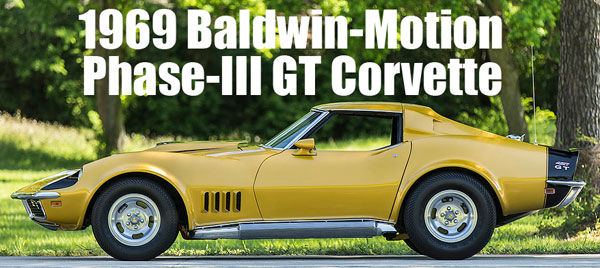
Rosen pitched to Baldwin Chevrolet’s Ed Simonin a new way for buyers to get a brand new, turn key “super” muscle car, with a proven, reliable setup – ready to rock! By 1968 the full “Fantastic Five” lineup of cars was established, featuring Phase III SS-427 versions of the Chevy Biscayne, Nova, Chevelle, Camaro, and Corvette. For just $3,495 you could buy the ultimate street sleeper, the SS-427 Biscayne. Or, if your POCKETS were really deep, for $6,995.85 (an enormous amount of cash beck then) you could get the Phase III SS-427 Corvette. Each car was custom made to order, so every car was slightly different. What’a heady time to be into the high performance street scene.
As “they” say, the rest is history, and since you wouldn’t be here if you already weren’t familiar with the Baldwin Motion story, we don’t need to retell the entire story. Mr. Motion is now semi-retired and living the good life in warm, sunny Florida. With the Baldwin Motion brand back in action and in very good hands, thanks to his relationship with Howard Tanner, Redline Motorsports in Schenectady, and DeNooyer Chevrolet, Albany, New York.
I thought the Baldwin Motion fans would enjoy hearing from the original Mr. Motion, Joel Rosen. So, one evening in early July 2011, Joel and I had an interesting conversation. Here goes…
Scott – How did the new Baldwin Motion deal come about?
Joel - Well, it was a little bit of a bumpy start, but we turned it into a very positive deal. DeNooyer Chevrolet and Howard Tanner had been marketing Howard’s “HTR” Camaros and Corvettes for a while. It was kind of like what I was doing with Baldwin Chevrolet back in the day. DeNooyer and Tanner were building new Chevy supercars, ala the Phase III cars. A friend of ours contacted us letting us know that these guys in upstate New York that were using modified versions one of Marty Schorr’s old Baldwin Motion ads – WANTED! – in their advertising.
I didn’t know who they were but when I learned what they were doing, we worked out a deal for DeNooyer and Tanner to work with me and build and market Baldwin-Motion Gen V 427 & 454 Camaros. They even painted up the front showroom windows the same way we did at the Baldwin Chevrolet dealership. Just like that famous photo with “Fantastic Five” on the windows. It was pretty cool. And part of the deal was that I would be able to order Phase III 427-SC Camaro #01.
I did a lot of research on Howard and DeNooyer and must say that they have my full respect. Howard can do anything with modern performance cars, knows the electronics such that he can build the engines to specific horsepower levels, then adjust the electronics to get the car‘s emissions right. We couldn’t do any of that back in our day. They didn’t even have computers controlling fuel and spark. We were just told that we couldn’t remove ANY emissions devices. A lot’s changed. Continue reading
Vette Polls: What’s Your Favorite 1968-1982 Shark Corvette?
Dateline: 10.5.11
The Mako Shark II show car styling forever defined the “Corvette look.” What’s your favorite? Take our poll at the end of this post!

The Mako Shark-II show car was about 7/8s the size of the production '68 Corvette. Or at least, it looked that way.
The 1965-1966 Mako Shark-II show car was so over the top, it just had to be the next Corvette! Chevrolet management was so jazzed they wanted it a year! The first Mako Shark-II was a non-running car and was shown to Chevrolet management in Spring of 1965. I guess because the chassis and running gear would be a carry over from the then current Sting Ray, management thought a totally new body and interior could be designed and developed in time for Fall ‘66 delivery to showrooms as a ‘67 model – 18 months? No way!
So the schedule was pushed back a year to Fall ‘67 as a ‘68 model – and even that was pushing it! The end result was that ‘68 models were, shall we say, challenging. Even through everyone’s socks were going up and down over the look of the car, customers were shocked at how rough their premium car was. The new Shark Corvette should have been introduced as a ‘69 model, but hindsight is 20/20. The ‘69 model was a big improvement and things went from there.
Of course, we all tend to think that things will always improve, right? So when the ‘70 Corvettes came out with their LT-1 small-blocks, and enlarged, 454 big-blocks, we all assumed things were going to get even better. But a one-two punch landed squarely on the jaw of performance cars with a right jab from the insurance companies and a left hook from the oil companies and new environmental concerns. While getting the lead out of gasoline was a good thing, it took a long time for performance to recover. 1970 turned out to be the high watermark for performance and it was downhill for almost 15 years.
While the performance party was definitely over in the ‘70s and car makers were dropping their muscle cars like hot potatoes, it turned out to be a good thing for Corvettes. Continue reading
Corvettes Score 23% in Edmonds 100 Greatest Chevrolets List
Dateline: 9.27.11
Of the 23 Corvettes Edmonds picked, vote for your favorite at the end of this post!
Back on September 14, 2011 we shared with you the results of Chevrolet’s Centennial birthday celebration popularity contest to find the most popular Chevrolet of all-time. Like American Idol or Dancing With the Stars, the Greatest Chevy contest was a popularity contest. Certainly an argument could be made as to why the C6 ZR1 is the greatest Chevy of all-time because of its overall performance, the LS9 engine, top speed, etc. But that’s not what Chevrolet wanted to know. They wanted to know what was the most “favorite” Chevy of the last 100 years.
Well it seems that the people at Edmonds.com decided to draw up their own list of great Chevys. The 100 top Chevys list isn’t limited to production Chevrolet cars, but includes, race cars, prototypes, and show cars. Of the 100 cars in the list, 23 were Corvettes! Pretty impressive for a low-volumn, limited usage automobile. The list doesn’t appear to be in any specific order and there’s a slide show of all 100 cars too. Also, the story does not explain how this list was drawn up. Regardless, it’s interesting just the same. To review the Edmonds story, CLICK HERE.
Here are the 23 Corvettes:
1. 1953 Corvette – The First Corvette.
2. 1955 265 V8 Corvette – The first V8 Vette.
3. 1957 Fuel Injected Corvette – The First Fuelie Corvette
4. 1956 SR-2 Corvette Race Car
5. 1957 Corvette SS Race Car
6. 1959 Stingray Racer – Bill Mitchell’s race car playtoy Continue reading
Corvette Pace Cars – The First Indy 500 Corvette Pace Car
Dateline: 9.19.11
From the Archives of The Illustrated Corvette Series
The Corvette’s tough-guy legend is founded on racing and performance. By the mid-to-late ‘70s, Corvette high-performance and racing efforts were in the pits. Power was down, weight was up, and Porsches were eating the Corvette’s lunch at the race track. The announcement that the 25th anniversary Corvette would also be the pace car at the ’78 Indy 500, looked like the highlight of the decade for Corvette fans. But controversy was in the mix right from the beginning.
Initially, it looked like a triple-play for Chevrolet. First, the ’78 Corvette received a sleek new fastback roof that completed the overall redesign started in ’73 with the soft bumper covers. Second, all Corvettes wore the 25th Anniversary badges. And third, three special Corvettes would serve as the pace cars at the ’78 Indy 500, and replicas would be available. Then the details set in.
The initial proposal was that there would be 300 pace car replicas, the same number as the ’53 production run. The car would have a two-tone silver paint (for the silver anniversary), red pin striping, and special Goodyear tires with “CORVETTE” sidewall lettering. Then the plan was to make 2,500 replicas, 100 for each year of production. But there were 6,200 dealers that all wanted at least one replica, so production went up to 6,502 units. Then two key elements were changed. The special “CORVETTE” tires were deemed too expensive, and paint was changed to sliver and black.
Then there was the price issue. The RPO 1YZ8778 package cost $4,302, on top of the $9,351 base price – a 46-percent premium! Here’s what came with the option. The exterior had special two-tone paint and pin striping, unique front and rear spoilers, glass roof panels, sport mirrors, and red pin stripped aluminum wheels on P225/60R15 tires. The interior came with power windows and door locks, tilt-telescopic steering column, convenience group, silver thin-shell seats, AM/FM with a CB radio or an 8-track tape player, dual rear speakers, and a power antenna. The $525 L82 engine rated at 220-hp was not part of the package.
The controversy started right on the showroom floor. For a premium collectible,” quality was not good. On many of the cars, fender seams and slight bubbles were clearly visible. The black upper body paint only made the defects look worse. Then there were the opportunistic dealers who tacked on surcharges that bumped the price up to between $15,000 to $22,000. Continue reading
Vette Videos: SUPER RARE, One-of-a-Kind 1972 Motion Moray Eel Corvette
Dateline: 9.15.11
The last of Joel Rosen’s Shark Corvettes – The Moray Eel
As cool as the Mako Shark-styled production 1968 Corvette was, there were a few that were… disappointed. Why, you wonder? Because the ‘68 Corvette WASN’T the ‘65-’66 Mako Shark II show car. Making a show car is one thing, designing a car to be mass produced is another. While the Mako Shark II show car looked large on the stage, it was actually about 7/8s the size of the production Corvette. In other words, a VERY tight little package that could not directly translate into a production car.
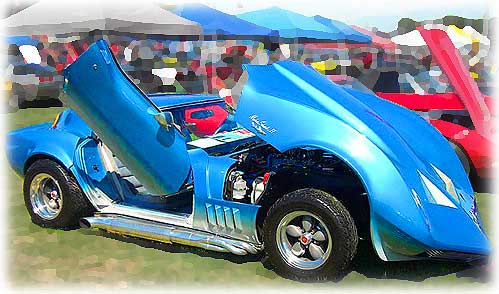
But it was fiberglass man, John Silva that took it upon himself to make his own Mako Shark. “Kit cars” were all the rage in the mid-to-late ‘60s. Meanwhile, on Long Island, New York, Joel Rosen was building ground-pounding big-block Phase III Chevys and was looking for something really exotic to offer his Corvette customers. Rosen bought two complete Silva Maco cars and got permission from Silva to make molds off of the Silva parts to make his Motion Maco kits. The Maco kits were kind of a “love it, or hate it” thing. It wasn’t quite as svelte as the Mako Shark, but for many, it was close enough.
For creative types, such as Rosen, the mind never stops. In the early ‘70s Joel was on a roll with his “shark-thing.” His Motion Maco Shark burst on the street scene in ‘71, quickly followed by two interesting variations. The Manta Ray featured the front end of the Phase III GT with its distinctive tunneled headlights and Continue reading
Marty Schorr’s “Car Guys Who Lunch” Car Club – Start Your own Chapter!
Dateline: 9.13.11
“There’s only ONE rule – Be a real car guy, or be GONE!”
- Martyn L. Schorr, OWner of Sarasoda Cafe Racers Car Club
Marty will probably blush over this, but I’ll say it. Marty Schorr has made a larger contribution to not just the Corvette world, but to automotive hobbyists all over. Marty was at the helm of High-Performance CARS magazine for nearly 20 years. But “CARS” wasn’t the only pub Marty drove. He was also editor of Chevy Action, Speed and Super Car, the founder of VETTE Magazine and Thunder-AM, plus dozens of CARS Annual special editions and a few dozen stand alone car books. His latest book “Motion Performance – Tales of a Muscle Car Builder” is the official history of the Baldwin-Motion experience, as told by the man that helped create the whole shebang! As front man for the Baldwin-Motion experience, Marty provided those wonderful, “in-your-face” PR, advertising, brochures, and catalog campaigns for the successful Phase III Supercars. The list just goes on and on. “Prolific” is an understatement. And now, we should also add “car club impresario” to Marty’s list of accomplishments.

Marty isn't late, but as Maitre d’ café & CCO (Chief Communications Officer), he likes to be at the restaurant first.
Car Guys Who Lunch started in 2003 when a group of dudes with gasoline in their veins got together for burgers and bench racing in a cafe in Sarasota, Florida. A good time was had by all with everyone agreeing, “Lets do it again!” Within a year, “Sarasota Cafe Racers” was officially launched, or should I say, “lunched.” (Arr, arr!) There are two aspects of Car Guys Who Lunch that make it so unique.